AI Customer Service: Cut Response Times by 40% in 6 Months

Anúncios
In today’s hyper-connected world, customer service is no longer just a department; it’s a critical differentiator, a brand-building powerhouse, and a direct determinant of customer loyalty and business growth. For US companies, the stakes are particularly high. Consumers expect instant gratification, personalized experiences, and resolutions that are both swift and accurate. The traditional model of customer service, often plagued by long wait times, inconsistent responses, and overwhelmed agents, is simply no longer sustainable. This is where the transformative power of AI Customer Service comes into play.
Imagine cutting your customer response times by a staggering 40% within the next six months. This isn’t a futuristic fantasy; it’s an achievable reality for US companies willing to strategically embrace artificial intelligence. This comprehensive guide will delve into how AI can revolutionize your customer service operations, providing actionable strategies, tangible benefits, and a clear roadmap to achieve significant improvements in efficiency and customer satisfaction.
Anúncios
The Imperative for Speed: Why Response Times Matter More Than Ever
Before we dive into the ‘how,’ let’s firmly establish the ‘why.’ In the digital age, customer patience is a dwindling resource. A study by HubSpot revealed that 90% of customers rate an ‘immediate’ response as important or very important when they have a customer service question, with ‘immediate’ often defined as 10 minutes or less. Delaying a response, even by a few minutes, can lead to frustration, churn, and negative reviews that erode your brand reputation.
Long response times are a symptom of underlying inefficiencies, often stemming from:
Anúncios
- High Volume: An increasing number of inquiries overwhelming human agents.
- Repetitive Queries: A significant portion of questions are routine and could be automated.
- Lack of Self-Service Options: Customers are forced to contact support for simple issues.
- Agent Burnout: Overworked agents leading to slower, less attentive service.
- Fragmented Systems: Information silos making it difficult for agents to quickly find answers.
The consequences extend beyond customer frustration. Slow response times translate to:
- Lost Sales: Customers abandoning purchases due to unanswered pre-sales questions.
- Increased Churn: Dissatisfied customers taking their business elsewhere.
- Higher Operational Costs: More agents, longer handling times, and inefficient processes.
- Damaged Brand Reputation: Negative word-of-mouth and online reviews.
By focusing on reducing response times, US companies can not only mitigate these risks but also unlock significant opportunities for growth, loyalty, and competitive advantage. And the most powerful tool in this endeavor is AI Customer Service.
Defining Your 40% Reduction Goal: A Strategic Approach
Achieving a 40% reduction in response times within six months is an ambitious but entirely feasible target with the right AI strategy. This isn’t about simply throwing AI at the problem; it’s about a measured, phased approach that aligns with your business objectives and customer needs.
Baseline Assessment: Know Where You Stand
Before you can improve, you need to understand your current state. Conduct a thorough audit of your existing customer service operations:
- Average Response Time (ART): Measure this across all channels (email, chat, phone, social media).
- First Contact Resolution (FCR): How many issues are resolved on the first interaction?
- Customer Satisfaction (CSAT) & Net Promoter Score (NPS): Gauge current customer sentiment.
- Common Query Types: Categorize and quantify the most frequent customer questions.
- Agent Workload & Efficiency: Analyze agent utilization, average handling time (AHT), and areas of struggle.
- Current Technology Stack: Identify existing tools and their limitations.
This data will form your baseline and allow you to set realistic, measurable targets for your AI Customer Service implementation.
Setting SMART Goals for AI Implementation
Your 40% reduction goal should be broken down into Specific, Measurable, Achievable, Relevant, and Time-bound (SMART) objectives. For example:
- Month 1-2: Deploy an AI-powered chatbot to handle 30% of repetitive Tier 1 inquiries, aiming for a 15% reduction in email response times.
- Month 3-4: Integrate AI-driven knowledge base suggestions for agents, improving FCR by 10% and reducing average call handling time by 5%.
- Month 5-6: Implement AI-powered sentiment analysis and intelligent routing to prioritize urgent cases, leading to a further 10% reduction in overall response times across critical channels.
These phased goals make the overall 40% target more manageable and allow for continuous optimization.
The AI Arsenal: Tools and Technologies for Rapid Response
The landscape of AI Customer Service solutions is vast and rapidly evolving. Here are the core technologies that will drive your response time reduction:
1. AI-Powered Chatbots and Virtual Assistants
These are often the first point of contact for customers and the most direct way to reduce initial response times. Modern chatbots, powered by Natural Language Processing (NLP) and machine learning, can:
- Instantly Answer FAQs: Handle common questions like ‘What’s my order status?’ or ‘How do I reset my password?’ without human intervention.
- Guide Users to Self-Service: Direct customers to relevant articles in your knowledge base.
- Collect Information: Gather necessary details before escalating to a human agent, streamlining the handoff.
- Provide 24/7 Support: Ensure customers receive immediate assistance regardless of business hours.
- Personalize Interactions: Use past data to offer tailored recommendations or solutions.
The key is to train them effectively on your specific business data and continuously monitor their performance to improve accuracy and user experience. This is foundational for any effective AI Customer Service strategy.
2. Intelligent Knowledge Management Systems
An AI-enhanced knowledge base is more than just a collection of articles. It uses AI to:
- Improve Search Functionality: Allow customers and agents to find relevant information quickly, even with vague queries.
- Auto-Suggest Answers: For agents, AI can proactively suggest answers based on the customer’s query, reducing research time.
- Identify Content Gaps: AI can analyze customer questions that aren’t being adequately answered, highlighting areas for new content creation.
- Keep Content Updated: AI can flag outdated information or suggest revisions based on user feedback and trends.
Empowering both customers and agents with quick access to accurate information is crucial for slashing resolution times.
3. AI-Driven Email and Message Automation
Email can be a bottleneck for many customer service teams. AI can significantly accelerate email responses by:
- Categorizing and Prioritizing Emails: Automatically tag incoming emails by topic and urgency, ensuring critical issues are addressed first.
- Drafting Automated Responses: For common queries, AI can generate personalized draft replies for agents to review and send, or even send fully automated responses.
- Extracting Key Information: AI can parse emails to identify customer details, order numbers, and specific requests, populating CRM fields automatically.
This reduces the manual effort involved in email management, freeing up agents for more complex tasks and directly impacting email response times.
4. Sentiment Analysis and Predictive Analytics
Beyond direct responses, AI can help preemptively address customer issues and prioritize interactions:
- Sentiment Analysis: AI can analyze customer language (in chat, email, social media) to detect frustration, urgency, or satisfaction. This allows for proactive intervention or immediate escalation of negative interactions.
- Predictive Analytics: By analyzing historical data, AI can predict which customers are at risk of churn or which issues are likely to escalate, allowing for proactive outreach.
- Intelligent Routing: AI can route customer inquiries to the most appropriate agent based on their expertise, past interactions, and the urgency of the issue, ensuring efficient resolution.
These capabilities shift your customer service from reactive to proactive, further reducing the perceived and actual wait times.
Implementation Roadmap: Achieving 40% Reduction in 6 Months
Here’s a phased approach for US companies to integrate AI Customer Service and achieve significant response time reductions:
Phase 1: Foundation & Pilot (Months 1-2)
- Objective: Establish baseline, identify low-hanging fruit, and deploy initial AI tools.
- Actions:
- Data Audit: Collect and analyze current response times, common queries, and agent performance.
- Identify Automation Opportunities: Pinpoint the 20-30% most frequent, repetitive questions suitable for immediate chatbot automation.
- Select & Configure Chatbot/Virtual Assistant: Choose an AI platform and train it on your core FAQs and business data.
- Pilot Deployment: Launch the chatbot on your website for a specific set of queries, closely monitoring its performance and collecting user feedback.
- Agent Training (Co-Pilot Mode): Train human agents on how to interact with the AI, escalate issues, and leverage its capabilities.
- Expected Outcome: Initial reduction in simple query volume, improved instant response for FAQs, and valuable data for further AI refinement.
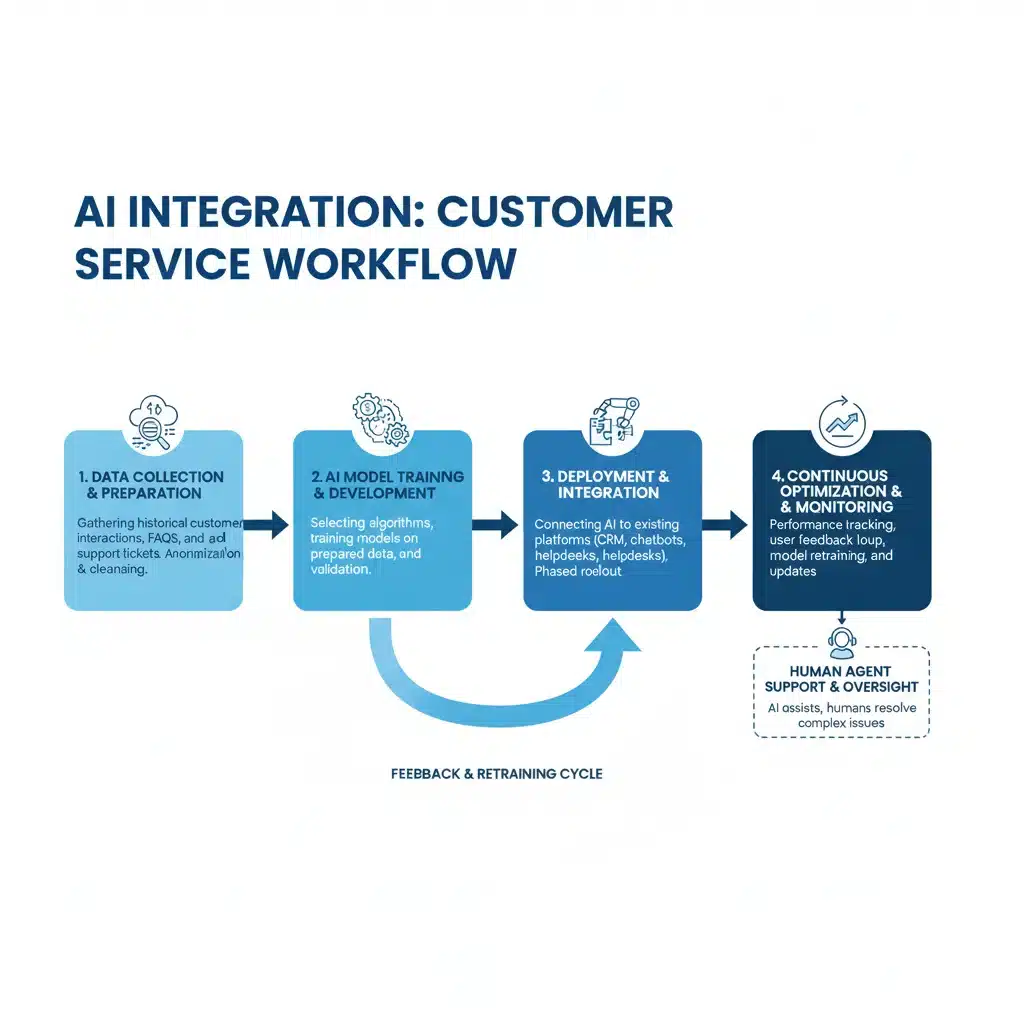
Phase 2: Expansion & Integration (Months 3-4)
- Objective: Expand AI capabilities, integrate with existing systems, and empower human agents.
- Actions:
- Knowledge Base Enhancement: Integrate AI search capabilities into your internal and external knowledge bases.
- Agent Assist Tools: Implement AI-powered tools that provide real-time suggestions and information to human agents during live chats or calls.
- Advanced Chatbot Features: Expand chatbot capabilities to handle more complex multi-turn conversations, gather more detailed customer information, and integrate with backend systems (e.g., order tracking).
- Email Automation for Triage: Implement AI to categorize and prioritize incoming emails, drafting responses for agents where appropriate.
- Data Integration: Connect your AI platforms with your CRM and other critical business systems for a unified customer view.
- Expected Outcome: Further reduction in average handling time, increased first contact resolution, and more efficient agent workflows.
Phase 3: Optimization & Proactivity (Months 5-6)
- Objective: Fine-tune AI, leverage advanced analytics, and move towards proactive customer service.
- Actions:
- Sentiment Analysis Deployment: Implement AI to monitor customer sentiment across channels, enabling proactive intervention for negative experiences.
- Intelligent Routing Optimization: Refine AI-driven routing rules to ensure inquiries reach the best-suited agent or department quickly.
- Predictive Service: Use AI to identify patterns and predict potential customer issues, enabling proactive outreach or self-service recommendations.
- Continuous Feedback Loop: Establish a robust system for collecting and acting on feedback from customers and agents to continually improve AI models.
- Performance Review & Iteration: Conduct a comprehensive review of all metrics against your 40% reduction goal. Identify areas for further improvement and plan future AI enhancements.
- Expected Outcome: Sustained reduction in response times, improved customer satisfaction, reduced agent burnout, and a highly efficient, data-driven customer service operation.
Overcoming Challenges in AI Customer Service Adoption
While the benefits of AI Customer Service are clear, successful implementation requires addressing potential hurdles:
- Data Quality: AI models are only as good as the data they’re trained on. Invest in cleaning and structuring your customer service data.
- Integration Complexities: Ensure your chosen AI solutions can seamlessly integrate with your existing CRM, helpdesk, and other business systems.
- Maintaining the Human Touch: AI should augment, not replace, human agents. Design your system to allow for smooth escalation to human support when needed, preserving empathy and complex problem-solving.
- Change Management: Prepare your team for the shift. Provide comprehensive training, communicate the benefits, and emphasize that AI is a tool to empower them, not replace them.
- Bias in AI: Be aware of potential biases in AI algorithms and data. Regularly audit your AI’s performance to ensure fair and equitable service for all customers.
- Measuring ROI: Clearly define your KPIs (like response times, FCR, CSAT, cost savings) to demonstrate the tangible return on investment of your AI initiatives.
Addressing these challenges head-on will pave the way for a smoother and more successful AI adoption journey.
The Human Element: Empowering Agents with AI
A common misconception is that AI Customer Service replaces human agents. In reality, it transforms their roles, empowering them to deliver higher-value service. By automating routine and repetitive tasks, AI frees up agents to focus on:
- Complex Problem Solving: Tackling unique, nuanced, or highly emotional customer issues that require human empathy and critical thinking.
- Relationship Building: Engaging in personalized conversations that foster loyalty and trust.
- Proactive Outreach: Using AI insights to identify and address potential problems before they escalate.
- Upskilling: Developing new skills in areas like AI oversight, data analysis, and advanced problem-solving.
AI tools, such as agent-assist features, provide agents with instant access to information, suggested responses, and customer context, making them more efficient and effective. This symbiotic relationship between AI and humans is the hallmark of modern, high-performing customer service. The goal isn’t fewer agents; it’s more effective, engaged, and satisfied agents.

Measuring Success and Continuous Improvement
Achieving a 40% reduction in response times is not a one-time event; it’s the result of continuous monitoring and optimization. Regularly track the following KPIs:
- Average Response Time (ART): The primary metric for this initiative.
- First Contact Resolution (FCR): Indicates how effectively issues are resolved.
- Customer Satisfaction (CSAT): Directly measures customer happiness with your service.
- Net Promoter Score (NPS): Gauges overall customer loyalty.
- Average Handle Time (AHT): For human agents, indicating efficiency.
- Chatbot Containment Rate: The percentage of queries resolved solely by the chatbot.
- Agent Utilization: How efficiently your human agents are being deployed.
- Cost Per Interaction: To quantify the financial benefits of automation.
Utilize the data generated by your AI Customer Service systems to identify trends, pinpoint areas for improvement, and refine your AI models. A/B test different chatbot scripts, update knowledge base articles, and continuously train your AI with new data. This iterative process ensures that your AI solutions remain effective and continue to deliver value.
Case Studies and Real-World Impact
Numerous US companies across various sectors have already demonstrated the profound impact of AI Customer Service. For instance:
- Telecommunications Giants: Have deployed AI chatbots to handle millions of customer inquiries monthly, significantly reducing call center volumes and average wait times.
- E-commerce Retailers: Use AI to manage order tracking, returns, and product inquiries, providing instant support and improving customer satisfaction, especially during peak seasons.
- Financial Services: Leverage AI for secure account inquiries, fraud detection, and personalized financial advice, enhancing both security and customer experience.
- Healthcare Providers: Employ AI for appointment scheduling, answering FAQs about services, and guiding patients to relevant resources, streamlining administrative tasks.
These examples underscore the versatility and effectiveness of AI in tackling diverse customer service challenges, all while driving down response times and elevating the overall customer experience.
The Future is Now: Embrace AI for a Competitive Edge
The journey to cutting customer service response times by 40% in six months is an investment in your company’s future. It’s an investment in happier customers, more efficient operations, and a stronger competitive position in the market. AI Customer Service is no longer a luxury; it’s a necessity for US companies aiming to thrive in the modern economy.
By strategically implementing AI-powered chatbots, intelligent knowledge bases, email automation, and advanced analytics, you can transform your customer service from a cost center into a powerful engine for customer loyalty and business growth. Start your journey today, define your goals, choose the right tools, and empower your team. The future of customer service is intelligent, instantaneous, and within your reach.