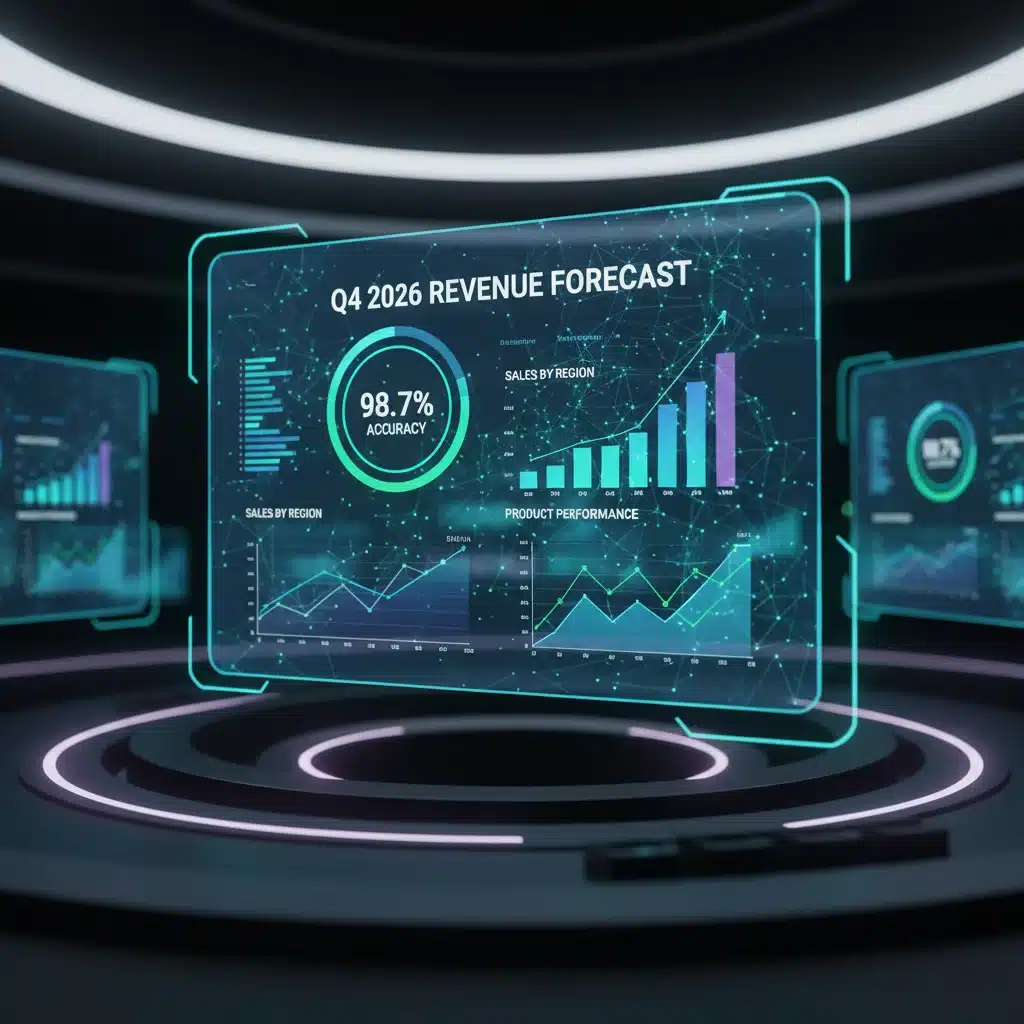
In the fiercely competitive landscape of modern business, the ability to accurately predict future outcomes is no longer a luxury but a fundamental necessity. For sales organizations, this means moving beyond gut feelings and historical trends to embrace sophisticated methodologies that can forecast revenue with unprecedented precision. Enter Predictive Sales Analytics – a revolutionary approach leveraging artificial intelligence (AI) to transform how businesses anticipate market shifts, optimize sales strategies, and achieve ambitious revenue targets. Imagine the power of forecasting your Q4 2026 revenue with a remarkable 90% accuracy. This article will delve into how AI-driven predictive analytics makes such a vision a tangible reality, providing a comprehensive guide for businesses aiming to stay ahead of the curve.
Anúncios
The traditional methods of sales forecasting, often reliant on historical sales data, anecdotal evidence, and educated guesses, are increasingly insufficient in today’s dynamic markets. These methods often fall short in accounting for complex variables, sudden market disruptions, or nuanced customer behaviors. This is where Predictive Sales Analytics shines. By employing advanced algorithms, machine learning models, and vast datasets, AI can uncover hidden patterns, identify critical drivers, and generate forecasts that are not only more accurate but also more adaptable to changing conditions. The goal is clear: empower sales leaders with actionable insights to make proactive decisions, allocate resources effectively, and ultimately, drive sustainable revenue growth.
The Evolution of Sales Forecasting: From Gut Feeling to AI-Driven Precision
For decades, sales forecasting was an art as much as a science. Sales managers would pore over spreadsheets, consult with their teams, and make projections based on past performance and current pipeline. While experience and intuition played a crucial role, these methods were inherently limited by human biases, the sheer volume of data, and the inability to process complex, multi-variate relationships. The advent of business intelligence tools brought some improvements, offering better visualization and reporting of historical data, but they still largely looked backward, not forward.
The true paradigm shift began with the integration of AI and machine learning into sales operations. AI models can ingest and analyze colossal amounts of data from various sources: CRM systems, ERPs, marketing automation platforms, external market data, social media trends, and even macroeconomic indicators. This comprehensive data ingestion allows AI to build a holistic picture of the sales environment, identifying correlations and causal relationships that would be impossible for human analysts to detect. The result is a level of foresight that transforms sales from a reactive function into a strategically proactive one.
Anúncios
Why Predictive Sales Analytics Matters for Q4 2026
Forecasting Q4 2026 revenue with 90% accuracy is an ambitious yet achievable goal with the right Predictive Sales Analytics framework. The benefits extend far beyond simply knowing what’s coming:
- Strategic Resource Allocation: Accurate forecasts allow businesses to allocate sales territories, assign quotas, and deploy marketing spend with optimal efficiency.
- Proactive Inventory Management: Knowing future demand helps optimize inventory levels, preventing stockouts or overstocking, which can significantly impact profitability.
- Enhanced Customer Experience: Understanding future customer needs and behaviors enables personalized outreach and improved service delivery.
- Risk Mitigation: Early identification of potential revenue shortfalls or market downturns allows for timely corrective actions.
- Competitive Advantage: Businesses with superior forecasting capabilities can respond faster to market changes, outmaneuvering competitors.
- Improved Financial Planning: Reliable revenue predictions are crucial for budgeting, investment decisions, and overall financial stability.
The Core Components of an AI-Driven Predictive Sales Analytics System
Building a robust Predictive Sales Analytics system involves several key components, each playing a vital role in data collection, processing, analysis, and prediction generation.
1. Data Collection and Integration
The foundation of any effective predictive model is high-quality, comprehensive data. This includes:
- CRM Data: Customer interactions, sales pipeline stages, deal sizes, close rates, lead sources, and historical sales performance.
- Marketing Data: Campaign performance, website traffic, conversion rates, customer acquisition costs.
- External Data: Economic indicators (GDP growth, inflation rates), industry trends, competitor activities, social media sentiment, weather patterns (for certain industries).
- Product Data: Product lifecycle, pricing, promotions, inventory levels.
Integrating these disparate data sources into a unified platform is crucial. Data warehouses and data lakes, often powered by cloud-based solutions, provide the necessary infrastructure for storing and accessing this vast amount of information.
2. Data Preprocessing and Feature Engineering
Raw data is rarely ready for direct use by AI models. This stage involves:
- Cleaning: Identifying and correcting errors, removing duplicates, handling missing values.
- Transformation: Converting data into a format suitable for analysis (e.g., normalizing numerical data, encoding categorical variables).
- Feature Engineering: Creating new variables (features) from existing ones that can enhance the model’s predictive power. For example, calculating average deal cycle length, lead-to-opportunity conversion rates, or customer lifetime value.
3. AI and Machine Learning Models
This is where the magic happens. Various AI and machine learning algorithms are employed, each suited for different types of predictions and data structures:
- Regression Models: (e.g., Linear Regression, Ridge, Lasso) for predicting continuous values like revenue amounts.
- Time Series Models: (e.g., ARIMA, Prophet, LSTM) specifically designed for forecasting data points collected over time.
- Classification Models: (e.g., Logistic Regression, Support Vector Machines, Random Forests) for predicting categorical outcomes, such as whether a deal will close or a customer will churn.
- Neural Networks: Deep learning models capable of identifying complex non-linear patterns in very large datasets, often used for highly accurate, long-term forecasts.
The choice of model depends on the specific forecasting objective, the nature of the data, and the desired level of accuracy.
4. Model Training and Validation
AI models learn from historical data. The dataset is typically split into training, validation, and test sets. The model is trained on the training data, fine-tuned using the validation set, and then evaluated on unseen test data to ensure its generalization capability. Key metrics for evaluating model performance include Mean Absolute Error (MAE), Root Mean Squared Error (RMSE), and R-squared for regression tasks, and accuracy, precision, recall, and F1-score for classification tasks.
5. Deployment and Monitoring
Once a model is trained and validated, it needs to be deployed into a production environment where it can generate real-time or near real-time predictions. Continuous monitoring of the model’s performance is essential. Data drift, concept drift, and changes in market conditions can degrade a model’s accuracy over time, necessitating retraining or recalibration.
Implementing Predictive Sales Analytics: A Step-by-Step Guide
Successfully integrating Predictive Sales Analytics into your sales operations requires a structured approach. Here’s a roadmap:
Step 1: Define Clear Objectives
Before diving into data, clearly articulate what you want to achieve. Are you aiming to forecast overall company revenue, predict individual sales rep performance, identify at-risk deals, or optimize pricing strategies? Specific objectives will guide your data collection and model selection.
Step 2: Assemble Your Team
A cross-functional team is crucial. This typically includes sales leaders, data scientists, business analysts, and IT professionals. Each brings unique expertise essential for success.
Step 3: Audit and Prepare Your Data
Identify all relevant data sources. Assess data quality and completeness. Invest in data cleaning and integration tools. Remember, “garbage in, garbage out” – the accuracy of your predictions is directly tied to the quality of your input data.
Step 4: Choose the Right Tools and Technologies
Consider cloud-based platforms (AWS, Azure, Google Cloud) for scalable data storage and processing. Explore specialized Predictive Sales Analytics software or CRM platforms with integrated AI capabilities. If building in-house, consider open-source libraries like TensorFlow or PyTorch for machine learning development.
Step 5: Develop and Train Predictive Models
Work with data scientists to select appropriate algorithms, build models, and rigorously test them. Focus on explainability – understanding why a model makes a particular prediction is as important as the prediction itself, especially for gaining trust from sales teams.
Step 6: Integrate Predictions into Sales Workflows
Predictions are only valuable if they are actionable. Integrate forecasting insights directly into your CRM, sales dashboards, and reporting tools. Sales reps should be able to see predicted close probabilities for their deals, and managers should have access to real-time revenue forecasts.
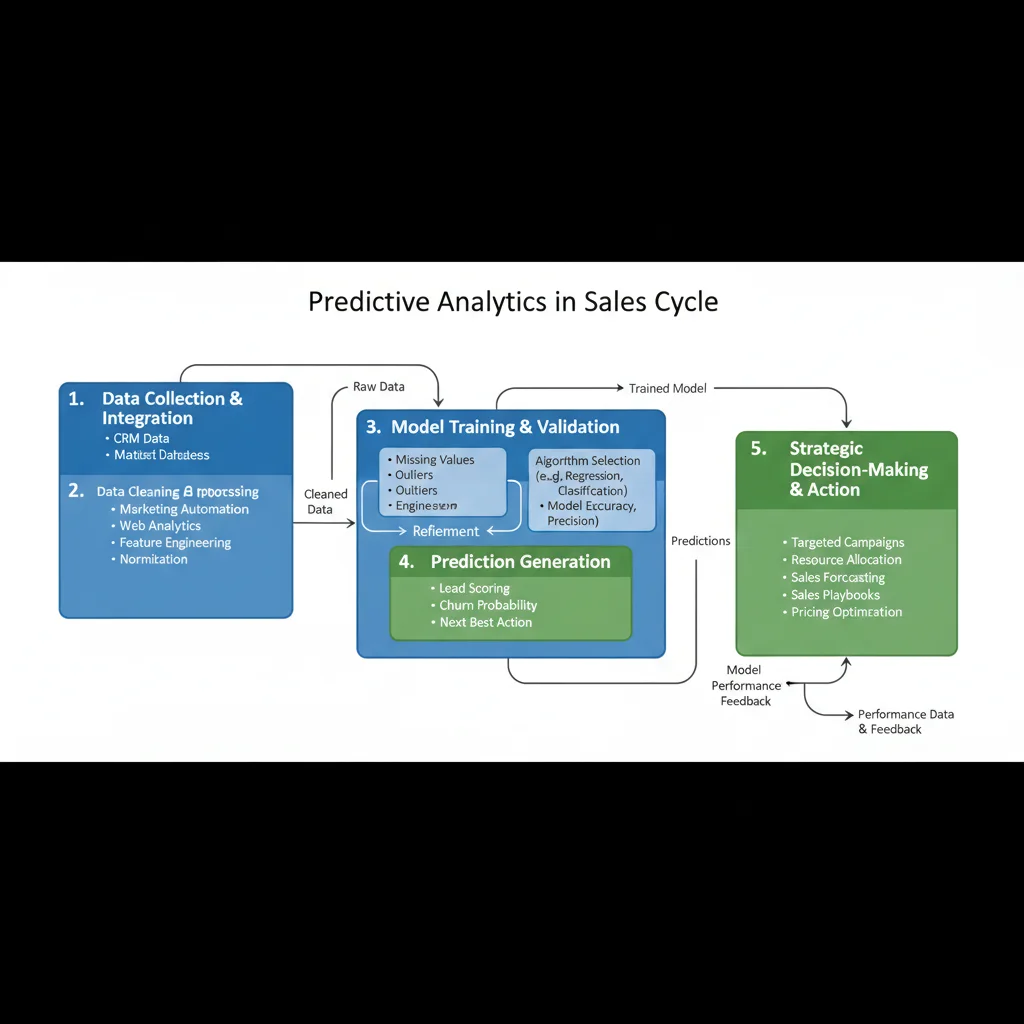
Step 7: Monitor, Refine, and Iterate
Predictive Sales Analytics is not a one-time project. Continuously monitor model performance, gather feedback from sales teams, and retrain models with new data. Market conditions change, customer behaviors evolve, and your models must adapt.
Common Challenges and How to Overcome Them
While the benefits of Predictive Sales Analytics are immense, implementation can come with challenges.
Data Quality and Availability
Challenge: Inconsistent, incomplete, or siloed data. Many organizations struggle with disparate data sources and poor data hygiene.
Solution: Invest in robust data governance strategies, data integration platforms, and data quality tools. Prioritize data cleanliness from the outset. Implement automated data validation processes.
Lack of Data Science Expertise
Challenge: Shortage of skilled data scientists and AI engineers to build and maintain models.
Solution: Consider partnering with specialized consulting firms, leveraging AI-as-a-Service platforms, or investing in upskilling existing employees. Many modern tools offer low-code/no-code AI capabilities that can empower business analysts.
Resistance to Change
Challenge: Sales teams may be hesitant to adopt new technologies, fearing job displacement or added complexity.
Solution: Emphasize how AI augments human capabilities, provides better leads, and simplifies tasks. Involve sales teams in the development process, demonstrate quick wins, and provide comprehensive training. Highlight the benefits of achieving targets more consistently.
Model Interpretability
Challenge: “Black box” AI models can be difficult to understand, leading to distrust.
Solution: Focus on explainable AI (XAI) techniques. Use models that provide insights into which factors influenced a prediction. Communicate the “why” behind the “what” to build confidence and facilitate adoption.
Maintaining Model Accuracy Over Time
Challenge: Models can degrade due to changes in market dynamics, customer behavior, or internal processes.
Solution: Implement continuous monitoring systems for model performance. Set up alerts for significant drops in accuracy. Establish a regular retraining schedule using fresh data. Consider adaptive learning models that can automatically adjust to new patterns.
Real-World Impact: How Predictive Sales Analytics Drives Success
The impact of Predictive Sales Analytics extends across various aspects of sales and business operations. Companies that successfully implement these systems report significant improvements in:
- Sales Forecasting Accuracy: Moving from 60-70% accuracy to 85-95% is not uncommon, leading to more reliable financial planning.
- Sales Cycle Efficiency: AI helps identify the most promising leads and optimal sales paths, reducing sales cycle length.
- Customer Churn Reduction: By predicting customers at risk of churning, businesses can proactively intervene with retention strategies.
- Upselling and Cross-selling Opportunities: AI can identify patterns in customer purchases and suggest relevant additional products or services, increasing customer lifetime value.
- Personalized Engagement: Understanding customer preferences through predictive models allows for highly personalized marketing and sales outreach, improving conversion rates.
- Optimized Pricing Strategies: Predictive models can analyze market demand, competitor pricing, and customer willingness to pay to suggest optimal pricing for products and services.
Consider a scenario where a B2B software company uses Predictive Sales Analytics to identify which trial users are most likely to convert to paid subscriptions. By analyzing usage patterns, engagement levels, and demographic data, the AI model can score trial users, allowing sales reps to prioritize their efforts on the most promising prospects. This leads to higher conversion rates and a more efficient use of sales resources. Similarly, a retail chain could use predictive analytics to forecast demand for specific products in different geographic regions, optimizing inventory distribution and reducing waste.
The Future of Sales: AI as a Strategic Partner
As we look towards Q4 2026 and beyond, AI will become an even more indispensable strategic partner in sales. The capabilities of Predictive Sales Analytics will continue to evolve, incorporating more sophisticated deep learning techniques, real-time data streams, and even generative AI for crafting personalized sales communications. The focus will shift from merely predicting to prescribing – AI not only telling you what will happen but also recommending the best course of action to achieve desired outcomes.

Imagine AI models that can analyze a sales call in real-time, providing the salesperson with prompts for handling objections, suggesting next best actions, or even identifying emotional cues from the prospect. This level of real-time intelligence will empower sales professionals to perform at their peak, transforming every interaction into an opportunity for success. Furthermore, the integration of predictive analytics with other emerging technologies like virtual reality (VR) and augmented reality (AR) could create immersive sales training environments or interactive product demonstrations tailored to predicted customer interests.
The ethical implications of AI in sales, particularly regarding data privacy and algorithmic bias, will also become increasingly important. Companies must prioritize responsible AI development, ensuring fairness, transparency, and accountability in their predictive models. Building trust in these systems, both internally and with customers, will be paramount for widespread adoption and sustained success.
Conclusion: Embracing the Future with Predictive Sales Analytics
Achieving 90% accuracy in Q4 2026 revenue forecasting is not a pipe dream; it’s a testament to the transformative power of Predictive Sales Analytics. By harnessing the capabilities of AI and machine learning, businesses can move beyond reactive sales strategies to embrace a proactive, data-driven approach. This journey requires commitment to data quality, investment in the right technologies, and a willingness to foster a culture of data-informed decision-making.
The benefits – from optimized resource allocation and reduced risk to enhanced customer experiences and significant revenue growth – far outweigh the challenges. As the business world continues its rapid evolution, those who embrace Predictive Sales Analytics will be the ones best positioned to navigate uncertainty, seize opportunities, and achieve unparalleled success. Start your journey today to unlock the full potential of your sales organization and secure a prosperous future.