The digital landscape is evolving at an unprecedented pace, and for US businesses, cloud computing has become the backbone of innovation, scalability, and operational efficiency. However, with great power comes great responsibility – specifically, the responsibility to manage cloud spending effectively. As we look towards 2026, the imperative for robust cloud cost optimization strategies is more critical than ever. This comprehensive guide provides insider knowledge and actionable strategies designed to help US businesses save a significant 10-25% on their monthly cloud expenditures, ensuring sustainable growth and maximizing return on investment.
Cloud adoption continues to surge, but so does the complexity of managing cloud finances. Many organizations find themselves grappling with unexpected costs, underutilized resources, and a lack of visibility into their cloud environments. This article will delve deep into the nuances of cloud financial management, offering practical advice and forward-looking insights to navigate the evolving cloud economic landscape.
Anúncios
The Evolving Landscape of Cloud Costs in 2026
Before diving into specific optimization techniques, it’s crucial to understand the current and projected state of cloud costs. In 2026, we anticipate several key trends influencing cloud spending:
- Increased Multi-Cloud and Hybrid Cloud Adoption: Businesses are increasingly leveraging multiple cloud providers (AWS, Azure, GCP) and integrating them with on-premise infrastructure. While this offers flexibility, it also introduces complexity in cost management and requires specialized cloud cost optimization tools.
- Rise of Serverless and Container Technologies: Technologies like AWS Lambda, Azure Functions, and Kubernetes offer immense scalability and efficiency but demand precise sizing and monitoring to avoid runaway costs.
- AI and Machine Learning Workloads: The proliferation of AI/ML initiatives, often requiring high-performance computing and specialized hardware (GPUs), will significantly impact cloud budgets. Optimizing these resource-intensive workloads will be a key challenge.
- Data Egress and Ingress Charges: As data volumes grow and move across regions and clouds, data transfer costs will remain a significant, often overlooked, component of cloud bills.
- SaaS and PaaS Sprawl: The ease of adopting SaaS and PaaS solutions can lead to a fragmented ecosystem, making it harder to track and optimize spending across various vendors.
Understanding these trends is the first step towards effective cloud cost optimization. Without this foundational knowledge, businesses risk making suboptimal decisions that fail to address the root causes of excessive spending.
Anúncios
Pillars of Effective Cloud Cost Optimization: A Strategic Framework
Achieving 10-25% savings on monthly cloud spending isn’t a one-time task; it’s a continuous journey that requires a strategic, multi-faceted approach. Here are the core pillars of effective cloud cost optimization:
1. FinOps Culture and Governance
FinOps, or Cloud Financial Operations, is more than just a set of tools; it’s a cultural shift that brings financial accountability to the variable spend model of cloud. It encourages collaboration between finance, operations, and development teams. Key aspects include:
- Establishing a FinOps Team: Designate individuals or a cross-functional team responsible for monitoring, analyzing, and optimizing cloud costs. This team acts as the central hub for all cloud cost optimization initiatives.
- Clear Policies and Guidelines: Develop and enforce policies for resource provisioning, tagging, and decommissioning. This ensures consistency and prevents shadow IT or unapproved resource deployments.
- Budgeting and Forecasting: Implement robust budgeting and forecasting processes. Leverage historical data and future project plans to predict cloud spend accurately and identify deviations early.
- Cost Allocation and Chargeback/Showback: Implement granular cost allocation mechanisms using tagging strategies. Chargeback (billing departments for their cloud usage) or showback (displaying usage costs without direct billing) fosters accountability and encourages responsible consumption.
2. Resource Optimization and Rightsizing
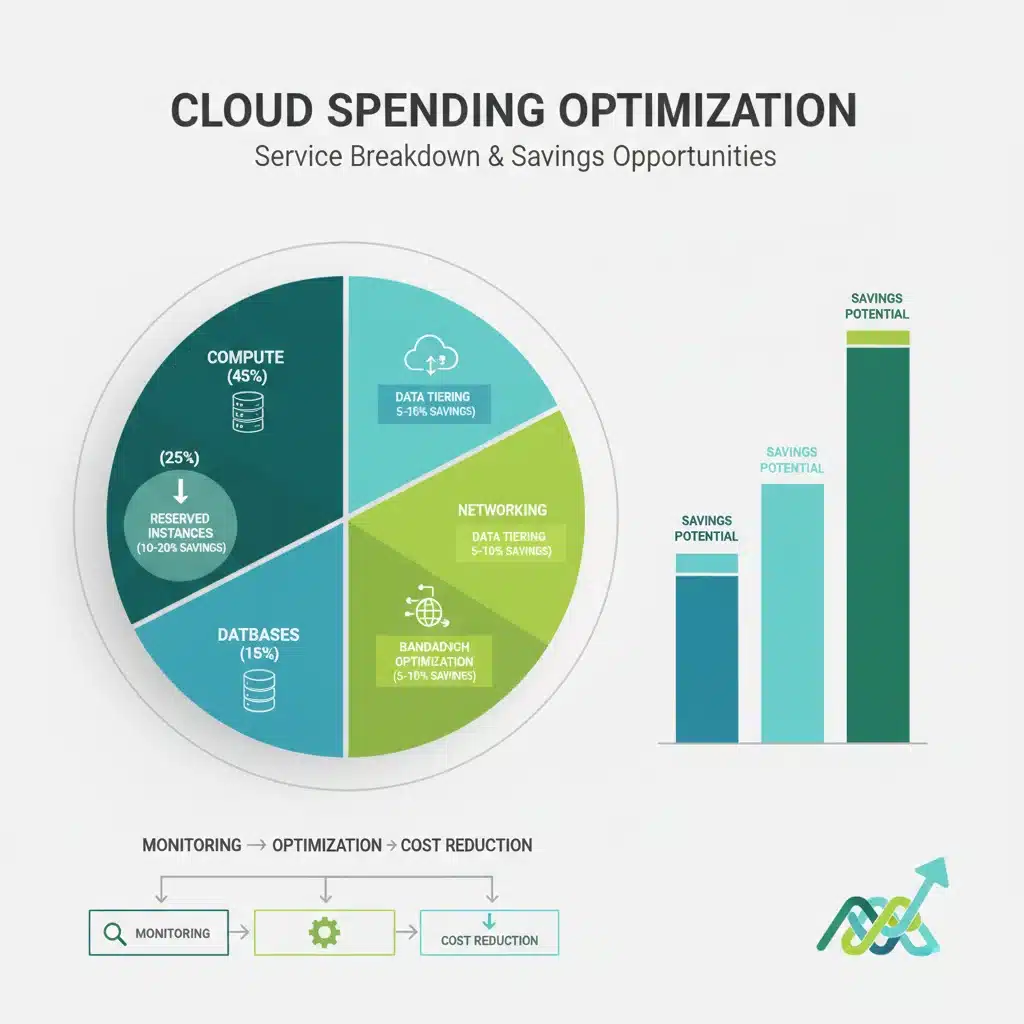
One of the most immediate and impactful areas for cloud cost optimization is ensuring that your resources are appropriately sized for their workloads. Over-provisioning is a common culprit of wasted spend.
- Identify and Terminate Idle Resources: Regularly scan for and shut down or terminate unused virtual machines, databases, storage volumes, and other resources. This can yield significant savings, especially in development and testing environments.
- Rightsizing Compute Instances: Analyze CPU, memory, and network utilization metrics to adjust instance types to match actual workload requirements. Many tools offer recommendations for rightsizing EC2 instances, Azure VMs, or GCP Compute Engine instances.
- Optimizing Storage: Move infrequently accessed data to cheaper storage tiers (e.g., AWS S3 Glacier, Azure Cool Blob Storage, GCP Coldline). Implement lifecycle policies to automate this process. Delete old snapshots and unattached volumes.
- Database Optimization: Rightsizing database instances, optimizing queries, and leveraging serverless database options (like AWS Aurora Serverless) can drastically reduce costs.
- Network Optimization: Monitor data transfer patterns to identify and mitigate high egress costs. Consider content delivery networks (CDNs) for static content to reduce origin server load and egress fees.
3. Leveraging Cloud Provider Discounts and Pricing Models
Cloud providers offer a variety of pricing models and discounts that, if strategically utilized, can lead to substantial savings. This is a cornerstone of advanced cloud cost optimization.
- Reserved Instances (RIs) and Savings Plans: Commit to a certain level of compute usage for a 1-year or 3-year term in exchange for significant discounts (often 20-60%). This is ideal for stable, predictable workloads.
- Spot Instances/VMs: For fault-tolerant or flexible workloads, using spot instances (AWS) or low-priority VMs (Azure/GCP) can offer up to 90% savings compared to on-demand pricing. These resources can be interrupted, so they require careful application design.
- Volume Discounts: As your usage grows, cloud providers may offer tiered pricing, where higher volumes lead to lower per-unit costs.
- Free Tiers and Credits: Don’t overlook free tiers for smaller projects or new services. Leverage cloud credits often provided for startups or specific initiatives.
- Enterprise Discount Programs (EDPs): For large enterprises, negotiating an EDP directly with the cloud provider can unlock significant savings based on committed spend.
4. Automation and Tools for Cloud Cost Optimization
Manual cloud cost optimization is unsustainable at scale. Automation and specialized tools are essential for continuous monitoring and proactive management.
- Cloud Cost Management Platforms (CMP): Tools like CloudHealth, Flexera, Apptio Cloudability, or native cloud provider tools (AWS Cost Explorer, Azure Cost Management, GCP Cost Management) provide visibility, reporting, and recommendations.
- Infrastructure as Code (IaC): Tools like Terraform, AWS CloudFormation, and Azure Resource Manager enable predictable and repeatable infrastructure deployment, preventing resource sprawl and ensuring adherence to cost policies.
- Auto-Scaling: Implement auto-scaling groups for compute resources to automatically adjust capacity based on demand, preventing over-provisioning during low-traffic periods and ensuring performance during peaks.
- Serverless Computing: Embrace serverless architectures (Lambda, Azure Functions, Cloud Functions) where appropriate, as you only pay for the exact compute time consumed, drastically reducing idle costs.
- Monitoring and Alerting: Set up alerts for budget thresholds, anomalous spending patterns, and underutilized resources to take immediate corrective action.
5. Architectural Best Practices and Application Modernization
Sometimes, the most significant savings come from re-evaluating your application architecture and modernizing legacy systems.
- Microservices Architecture: Breaking down monolithic applications into smaller, independent services allows for more granular scaling and resource allocation, leading to better cloud cost optimization.
- Event-Driven Architectures: Utilize message queues (e.g., AWS SQS, Azure Service Bus, GCP Pub/Sub) and event-driven patterns to decouple components, making systems more resilient and cost-efficient.
- Data Locality and Transfer: Design architectures that minimize data movement across regions or availability zones unless absolutely necessary, thereby reducing data transfer costs.
- Containerization: While Kubernetes can be complex, containerizing applications allows for higher resource utilization on underlying compute instances and easier portability.
- Caching Strategies: Implement caching at various layers (CDN, in-memory caches like Redis, database caching) to reduce database load and improve application performance, indirectly impacting compute costs.
Insider Knowledge: Advanced Strategies for 2026 Savings
Beyond the foundational pillars, here’s some insider knowledge to push your cloud cost optimization efforts beyond the typical 10% and closer to the 25% mark:
Deep Dive into Specific Cloud Provider Optimizations
AWS Specifics:
- Compute Optimizer: Leverage AWS Compute Optimizer for intelligent recommendations on rightsizing EC2 instances, Auto Scaling groups, and EBS volumes.
- Savings Plans for Fargate and Lambda: Extend the benefits of Savings Plans beyond EC2 to cover AWS Fargate and Lambda usage for deeper discounts on serverless compute.
- S3 Intelligent-Tiering: For data with unpredictable access patterns, S3 Intelligent-Tiering automatically moves objects between two access tiers to optimize storage costs without performance impact.
- Cost Anomaly Detection: Utilize AWS Cost Anomaly Detection to automatically identify unusual spending patterns and receive alerts, preventing unexpected budget overruns.
- Graviton Processors: Migrate suitable workloads to AWS Graviton-based instances, which often offer significant price-performance advantages over x86 processors.
Azure Specifics:
- Azure Advisor Recommendations: Regularly review Azure Advisor for personalized recommendations on cost, security, reliability, operational excellence, and performance.
- Azure Hybrid Benefit: Maximize savings by leveraging existing Windows Server and SQL Server licenses with Software Assurance on Azure.
- Reserved VM Instances: Purchase Azure Reserved VM Instances for predictable workloads to secure significant discounts. Consider one-year or three-year terms.
- Azure Dev/Test Subscriptions: Utilize special Dev/Test subscriptions to get discounted rates on Azure services for non-production environments.
- Azure Spot Virtual Machines: Use Spot VMs for stateless workloads, batch processing, or development/testing environments to capitalize on unused Azure capacity at a significant discount.
Google Cloud Platform (GCP) Specifics:
- Committed Use Discounts (CUDs): Similar to RIs, CUDs offer substantial discounts for committing to consistent resource usage for 1-3 years across various services like Compute Engine, Cloud SQL, and Google Kubernetes Engine.
- Sustained Use Discounts (SUDs): GCP automatically applies discounts for running Compute Engine instances for a significant portion of the billing month, requiring no upfront commitment. Monitor usage to ensure you’re maximizing these.
- Custom Machine Types: Create custom machine types in Compute Engine to precisely match your workload’s CPU and memory requirements, avoiding over-provisioning.
- Preemptible VMs: For fault-tolerant workloads, Preemptible VMs can be up to 80% cheaper than standard VMs, though they can be terminated by GCP.
- Cloud Storage Class Optimization: Regularly analyze access patterns and move data between Standard, Nearline, Coldline, and Archive storage classes to align with actual usage.

Optimizing Data Transfer and Networking Costs
- Minimize Cross-Region Transfers: Data transfer between different cloud regions is often expensive. Design your applications and data storage to keep data geographically close to its consumers.
- Leverage Private Connectivity: For hybrid cloud setups, consider direct connect (AWS), ExpressRoute (Azure), or Cloud Interconnect (GCP) for more predictable and potentially cheaper data transfer compared to public internet.
- Content Delivery Networks (CDNs): For public-facing applications, CDNs like CloudFront, Azure CDN, or Cloud CDN can significantly reduce egress costs by caching content closer to users and offloading traffic from your origin servers.
- Compress Data: Wherever possible, compress data before transferring it or storing it. Smaller data volumes mean lower transfer and storage costs.
Financial Governance and Vendor Management
- Regular Cost Reviews: Schedule monthly or quarterly reviews with stakeholders from finance, engineering, and product teams to discuss cloud spend, identify anomalies, and plan future optimizations.
- Vendor Negotiation: For large enterprises, don’t shy away from negotiating directly with cloud providers, especially as your committed spend increases.
- Benchmark Against Peers: Participate in industry surveys or leverage benchmarking tools to understand how your cloud spend compares to similar organizations. This can highlight areas for improvement.
- Leverage Third-Party FinOps Experts: If internal expertise is limited, consider engaging external consultants specializing in cloud cost optimization to conduct audits and implement strategies.
Common Pitfalls to Avoid in Cloud Cost Optimization
While pursuing savings, it’s easy to fall into common traps. Being aware of these can save you from costly mistakes:
- Sacrificing Performance for Cost: Aggressive optimization can sometimes lead to under-provisioning, resulting in performance degradation, poor user experience, and ultimately, business loss. Always balance cost with performance requirements.
- Ignoring Tagging Discipline: Without a consistent and comprehensive tagging strategy, visibility into who owns which resources and what they cost becomes impossible, hindering effective cost allocation and optimization.
- Set-It-and-Forget-It Mentality: Cloud environments are dynamic. What’s optimized today might be inefficient tomorrow. Cloud cost optimization is an ongoing process requiring continuous monitoring and adjustment.
- Lack of Communication: Silos between development, operations, and finance teams can lead to misaligned goals and missed optimization opportunities. FinOps culture is crucial to bridge these gaps.
- Over-reliance on Spot Instances for Critical Workloads: While spot instances are cheap, their interruptible nature makes them unsuitable for highly critical, stateful, or long-running production workloads without proper fault tolerance.
- Not Automating Decommissioning: Resources used for temporary projects, development, or testing are often left running long after they are needed. Automate the decommissioning or shutdown of these resources.
Measuring Success: KPIs for Cloud Cost Optimization
To ensure your cloud cost optimization efforts are bearing fruit, it’s essential to track key performance indicators (KPIs):
- Cost per Unit: Track cost per user, cost per transaction, or cost per API call to understand the efficiency of your cloud spend relative to business value.
- Cloud Spend Variance: Monitor the difference between actual and budgeted cloud spend.
- Resource Utilization Rates: Track CPU, memory, and storage utilization across your infrastructure.
- Savings Achieved: Quantify the actual savings realized from optimization efforts (e.g., from rightsizing, RIs, or decommissioning).
- Cost of Goods Sold (COGS): For product-based businesses, integrate cloud costs into your COGS to understand their impact on profitability.
- FinOps Maturity Score: Assess your organization’s FinOps maturity over time, identifying areas for improvement in culture, automation, and governance.
The Future of Cloud Cost Optimization: What’s Next for 2026 and Beyond
Looking ahead, cloud cost optimization will continue to evolve. Expect:
- AI-Powered FinOps: More sophisticated AI and machine learning will be embedded in cloud cost management tools, offering predictive analytics, anomaly detection, and automated optimization actions with greater precision.
- Sustainability as a Cost Factor: The environmental impact of cloud computing will become a more prominent consideration. Optimizing resource utilization will not only save money but also reduce carbon footprint, aligning with ESG goals.
- Enhanced Multi-Cloud Cost Management: As multi-cloud becomes standard, tools will offer more seamless and unified cost visibility and optimization across different providers.
- Shift-Left FinOps: Integrating cost considerations earlier in the development lifecycle (FinOps for developers) will become more prevalent, empowering engineers to make cost-aware design decisions.
- Rise of Cloud Native Cost Models: As serverless and container adoption grows, traditional VM-centric cost models will give way to more granular, event-driven, and consumption-based cost analysis.
Conclusion: A Continuous Journey to Cloud Financial Excellence
For US businesses, navigating the complexities of cloud spending in 2026 requires more than just reactive measures; it demands a proactive, strategic, and culturally integrated approach to cloud cost optimization. By implementing a robust FinOps framework, diligently optimizing resources, leveraging provider discounts, embracing automation, and designing for cost efficiency, organizations can realistically aim to save 10-25% on their monthly cloud bills.
The journey to cloud financial excellence is continuous. It requires constant vigilance, adaptation to new cloud services and pricing models, and a commitment to fostering a cost-conscious culture across all teams. Embrace these insider strategies, empower your teams with the right tools and knowledge, and transform your cloud spending from a potential drain into a powerful driver of business value and innovation.
Start today by auditing your current cloud spend, identifying immediate areas for improvement, and laying the groundwork for a sustainable cloud cost optimization program that will serve your business well into 2026 and beyond.