Ethical AI Development: US Guidelines & Best Practices for Responsible Automation

Anúncios
Ethical AI Development: New US Guidelines and 4 Best Practices for Responsible Automation in 2026
The rapid advancement of Artificial Intelligence (AI) presents both unprecedented opportunities and significant challenges. As AI systems become more sophisticated and integrated into every facet of our lives, the imperative for ethical AI development has never been greater. The year 2026 marks a pivotal moment, with new US guidelines emerging to shape the future of responsible automation. This comprehensive guide delves into these crucial developments and outlines four essential best practices for organizations committed to building AI that is fair, transparent, and beneficial to society.
Anúncios
The Evolving Landscape of Ethical AI Development
The journey towards truly responsible AI is complex and multifaceted, requiring a delicate balance between innovation and regulation. Historically, AI development has often prioritized technical prowess over ethical considerations, leading to concerns about bias, privacy, accountability, and potential misuse. However, a growing global consensus emphasizes the need for a human-centric approach to AI, ensuring that these powerful technologies serve humanity’s best interests.
Why Ethical AI Development Matters Now More Than Ever
The stakes are incredibly high. AI systems are increasingly deployed in critical domains such as healthcare, finance, employment, and criminal justice. Flawed or biased AI can lead to discriminatory outcomes, erode public trust, and even perpetuate societal inequalities. Moreover, the lack of clear ethical frameworks can hinder innovation by creating uncertainty and increasing the risk of costly legal and reputational damage for organizations. Proactive engagement with ethical AI development is not just a moral imperative; it’s a strategic necessity for long-term success and sustainability.
Anúncios
Key Challenges in Achieving Ethical AI
- Algorithmic Bias: AI models trained on unrepresentative or biased datasets can perpetuate and even amplify existing societal biases, leading to unfair decisions.
- Transparency and Explainability: Many advanced AI models, particularly deep learning networks, operate as “black boxes,” making it difficult to understand how they arrive at their conclusions. This lack of explainability hinders accountability and trust.
- Privacy Concerns: AI systems often require vast amounts of data, raising significant privacy concerns about data collection, storage, and usage.
- Accountability Gap: When an AI system causes harm, determining who is responsible (the developer, the deployer, the data provider) can be challenging.
- Security Risks: AI systems can be vulnerable to adversarial attacks, manipulation, or unintended consequences, posing security risks.
- Job Displacement and Economic Impact: The rise of automation through AI raises concerns about job displacement and the need for new economic models and workforce retraining.
Understanding the New US Guidelines for Responsible AI in 2026
Recognizing the urgency, the United States government has been actively working to establish comprehensive guidelines for ethical AI development. These guidelines, anticipated to solidify further by 2026, aim to provide a framework for both public and private sectors to develop and deploy AI responsibly. While specific legislative details are still evolving, the core principles revolve around promoting safety, fairness, privacy, and accountability.
The White House Blueprint for an AI Bill of Rights: A Foundation
A significant precursor to these guidelines is the White House Office of Science and Technology Policy’s (OSTP) “Blueprint for an AI Bill of Rights.” Published in 2022, this blueprint outlines five key principles that are expected to form the bedrock of future US AI policy:
- Safe and Effective Systems: AI systems should be safe, effective, and developed in consultation with diverse communities.
- Algorithmic Discrimination Protections: AI systems should not discriminate against individuals or groups, and their impact should be proactively assessed and mitigated.
- Data Privacy: Individuals should be protected from abusive data practices via built-in protections and the ability to exercise agency over their data.
- Notice and Explanation: People should know that an AI system is being used and understand how and why it affects them.
- Human Alternatives, Consideration, and Fallback: Individuals should have access to a human alternative, be able to opt out of AI systems, and have a human in the loop for critical decisions.
These principles are not merely aspirational; they are becoming actionable directives that organizations must integrate into their ethical AI development strategies. The US government’s approach emphasizes a risk-based framework, meaning that AI systems posing higher risks to individuals’ rights and safety will likely face more stringent oversight and requirements.
Anticipated Regulatory Landscape by 2026
By 2026, we can expect a more formalized regulatory landscape. This might include:
- Sector-Specific Guidance: Regulations tailored to AI applications in critical sectors like healthcare, finance, and transportation.
- Standards and Certifications: Development of industry-wide technical standards and voluntary or mandatory certification programs for AI systems.
- Increased Enforcement: Federal agencies like the FTC, DOJ, and EEOC will likely increase their enforcement actions against discriminatory or unfair AI practices.
- International Collaboration: Continued efforts to harmonize US guidelines with international frameworks, fostering global consistency in ethical AI development.
Organizations that proactively align their AI development processes with these emerging guidelines will be better positioned to navigate the regulatory environment, build public trust, and gain a competitive advantage.
4 Best Practices for Responsible Automation and Ethical AI Development
Adhering to guidelines is one thing; embedding ethics into the very fabric of AI development is another. Here are four critical best practices that organizations should adopt to ensure responsible automation and robust ethical AI development by 2026 and beyond.
1. Implement an AI Ethics Governance Framework
A strong governance framework is the bedrock of responsible AI. It provides the organizational structure, policies, and processes necessary to consistently address ethical considerations throughout the AI lifecycle. This isn’t a one-time setup; it’s an ongoing commitment to oversight and adaptation.
Key Components of an AI Ethics Governance Framework:
- Dedicated AI Ethics Committee: Establish a diverse committee comprising ethicists, technical experts, legal counsel, and representatives from affected communities. This committee should be responsible for setting ethical guidelines, reviewing AI projects, and addressing ethical dilemmas.
- Clear Ethical Principles and Policies: Define your organization’s core AI ethical principles (e.g., fairness, transparency, accountability, privacy, human oversight) and translate them into actionable policies that guide development and deployment.
- Risk Assessment and Mitigation: Develop systematic processes for identifying, assessing, and mitigating ethical risks associated with each AI project. This includes bias audits, privacy impact assessments, and security vulnerability testing.
- Accountability Mechanisms: Clearly define roles and responsibilities for ethical AI at every stage. Establish mechanisms for reporting ethical concerns and ensuring that corrective actions are taken.
- Continuous Monitoring and Auditing: Implement tools and processes to continuously monitor AI system performance, identify drift or emergent biases, and regularly audit compliance with ethical policies.
By formalizing these elements, organizations create a culture where ethical AI development is not an afterthought but an integral part of their operational DNA.
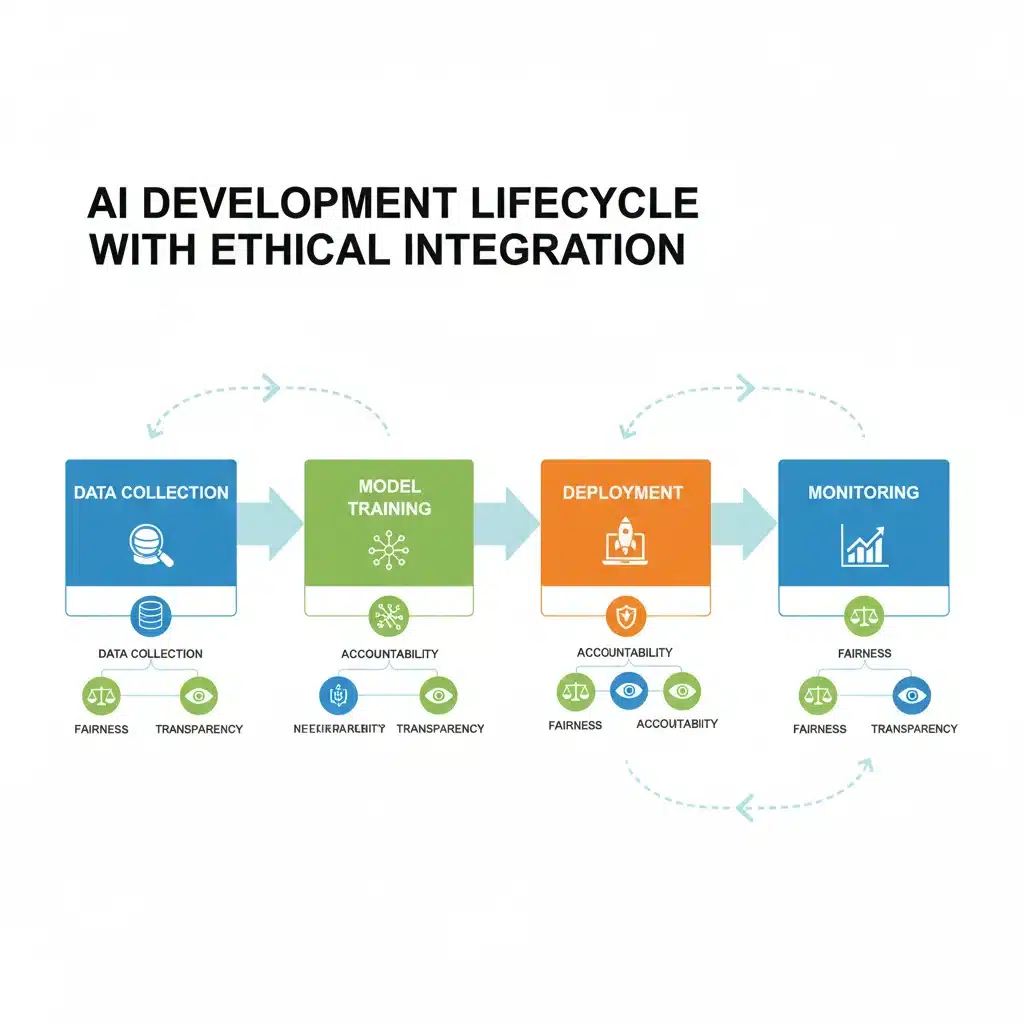
2. Prioritize Data Quality, Privacy, and Bias Mitigation
The adage “garbage in, garbage out” holds profound truth in AI. The quality and characteristics of the data used to train AI models directly impact their fairness, accuracy, and ethical performance. Addressing data-related issues is paramount for responsible AI.
Strategies for Data Ethics:
- Diverse and Representative Datasets: Actively seek out and curate datasets that are diverse and representative of the populations the AI system will serve. This helps reduce the risk of algorithmic bias.
- Bias Detection and Mitigation Tools: Utilize specialized tools and techniques to detect and quantify bias in datasets and AI models. This can involve statistical analysis, counterfactual fairness testing, and adversarial debiasing.
- Robust Data Governance: Implement strict data governance policies covering data collection, storage, access, and usage. Ensure compliance with privacy regulations like GDPR and CCPA, and anticipate future US privacy laws.
- Privacy-Preserving Technologies: Explore and implement technologies such as differential privacy, federated learning, and homomorphic encryption to train AI models while protecting sensitive individual data.
- Consent and Transparency in Data Collection: Be transparent with users about what data is being collected, why, and how it will be used. Obtain explicit consent where necessary.
A proactive approach to data ethics is a cornerstone of ethical AI development, ensuring that AI systems are built on a foundation of fairness and respect for privacy.
3. Ensure Transparency, Explainability, and Interpretability
For AI to be trusted, it must be understandable. Transparency, explainability, and interpretability are crucial for building confidence, enabling accountability, and allowing users to understand how AI decisions are made.
Approaches to Enhance AI Understanding:
- Explainable AI (XAI) Techniques: Employ XAI methods to make AI models more transparent. This includes techniques like LIME (Local Interpretable Model-agnostic Explanations), SHAP (SHapley Additive exPlanations), and attention mechanisms in deep learning.
- Model Documentation: Maintain thorough documentation for all AI models, detailing their purpose, training data, architecture, performance metrics, limitations, and ethical considerations.
- Clear Communication to Users: When AI systems interact with humans, provide clear and concise explanations about their function, limitations, and the rationale behind their decisions. This is especially important for critical applications.
- Human-in-the-Loop Design: Design AI systems to include human oversight and intervention, particularly for high-stakes decisions. Humans should have the ability to review, override, and correct AI outputs.
- Regular Audits and Validation: Conduct independent audits and validation of AI systems to verify their performance, identify unintended consequences, and ensure they adhere to ethical guidelines.
By prioritizing these aspects, organizations can demystify AI, fostering greater trust and facilitating responsible deployment, which is central to effective ethical AI development.
4. Foster a Culture of Continuous Ethical Learning and Adaptation
The field of AI is constantly evolving, and so too must our understanding and application of AI ethics. Responsible AI is not a static state but an ongoing process of learning, adaptation, and improvement.
Cultivating an Ethical AI Culture:
- Cross-Functional Training: Provide regular training on AI ethics for all employees involved in AI development, deployment, and management. This includes engineers, data scientists, product managers, legal teams, and leadership.
- Promote Ethical Dialogue: Encourage open discussions and critical thinking about ethical implications within project teams and across the organization. Create safe spaces for employees to raise concerns without fear of reprisal.
- Stay Updated on Research and Regulations: Actively monitor advancements in AI ethics research, emerging best practices, and evolving regulatory landscapes, both domestically and internationally.
- Iterative Ethical Review: Integrate ethical review into every stage of the AI development lifecycle, from conception and design to deployment and post-deployment monitoring. This allows for early detection and correction of potential issues.
- Stakeholder Engagement: Engage with external stakeholders, including ethicists, civil society organizations, affected communities, and industry peers, to gain diverse perspectives and insights into ethical challenges and solutions.
A commitment to continuous learning and adaptation ensures that an organization’s ethical AI development practices remain robust, relevant, and responsive to new challenges and societal expectations.

The Future of Ethical AI: Beyond 2026
While 2026 marks an important milestone with the solidification of US guidelines, the journey of ethical AI development extends far beyond. The future will likely see even greater integration of AI into complex societal structures, necessitating more sophisticated ethical frameworks and technological solutions. We can anticipate advancements in areas such as:
- AI for Good Initiatives: Increased focus on leveraging AI to address global challenges like climate change, disease, and poverty, always with a strong ethical foundation.
- Standardization and Interoperability: Development of global standards for ethical AI that allow for greater interoperability and consistent application across borders.
- Self-Improving Ethical AI: Research into AI systems that can detect and correct their own ethical shortcomings, potentially leading to more resilient and trustworthy automation.
- Societal Impact Assessments: More rigorous and mandatory assessments of the broader societal impacts of AI systems before and after deployment.
- Public Education and Literacy: Greater emphasis on educating the public about AI, its capabilities, limitations, and ethical considerations to foster informed public discourse and trust.
Organizations that invest in ethical AI development now will not only comply with future regulations but will also be at the forefront of shaping a positive and sustainable AI-powered future. They will be the trusted leaders in an increasingly automated world.