Navigating AI Ethics: Essential Frameworks for US Developers in Q1 2026

Anúncios
The Latest AI Ethics Frameworks: What US Developers Need to Know for Q1 2026 Deployments
The rapid evolution of Artificial Intelligence (AI) has brought unprecedented innovation, but also complex ethical challenges. As we approach Q1 2026, US developers find themselves at a crucial juncture, navigating an increasingly intricate landscape of AI ethics frameworks and regulatory expectations. The imperative for responsible AI development is no longer a theoretical debate; it is a concrete demand shaping the future of technology. Understanding and integrating the latest AI ethics frameworks is paramount not just for compliance, but for fostering trust, mitigating risks, and building sustainable AI solutions. This comprehensive guide will equip US developers with the knowledge and tools necessary to prepare for the ethical demands of Q1 2026.
Anúncios
The Evolving Landscape of AI Ethics Frameworks in the US
The United States has seen a significant push towards establishing clear guidelines for AI development. Unlike a single, monolithic piece of legislation, the US approach to AI ethics frameworks is a mosaic of executive orders, proposed legislation, agency guidance, and industry-led initiatives. This distributed approach requires developers to be agile and informed, constantly monitoring updates from various sources. The Biden administration, for instance, has emphasized a Blueprint for an AI Bill of Rights, outlining key principles such as safe and effective systems, algorithmic discrimination protections, data privacy, notice and explanation, and human alternatives. While not legally binding, this blueprint serves as a strong indicator of future regulatory direction and ethical expectations.
Furthermore, various federal agencies are developing sector-specific guidance. The National Institute of Standards and Technology (NIST) AI Risk Management Framework (AI RMF) stands out as a critical resource, offering a flexible and actionable framework for organizations to manage AI risks. It’s designed to be used voluntarily to improve the trustworthiness of AI systems. For US developers, understanding the NIST AI RMF is not optional; it’s foundational. It provides a structured approach to identifying, assessing, and mitigating risks associated with AI, covering areas like governance, data, model, and human-AI interaction. Incorporating the NIST AI RMF principles into your development lifecycle by Q1 2026 will be a significant step towards compliance and responsible innovation.
Anúncios
State-level initiatives also contribute to this complex environment. California, for example, with its robust privacy laws like the CCPA and CPRA, often sets precedents that influence national discussions on data governance within AI. Other states are exploring their own AI-specific legislation, particularly concerning facial recognition, algorithmic transparency, and bias. This fragmented but evolving regulatory landscape necessitates a proactive approach from developers to integrate robust ethical considerations from the outset of any AI project.
Key Principles of Responsible AI: A Developer’s Checklist for Q1 2026
At the core of all modern AI ethics frameworks are several recurring principles that US developers must internalize. These principles serve as guiding stars for building AI systems that are not only technologically advanced but also socially beneficial and trustworthy. By Q1 2026, demonstrating adherence to these principles will be crucial.
- Fairness and Non-Discrimination: This principle dictates that AI systems should not perpetuate or amplify unfair biases, and should treat all individuals equitably. Developers must actively work to identify and mitigate biases in training data, algorithms, and model outputs. This involves rigorous testing for disparate impact across different demographic groups and implementing techniques like adversarial debiasing or re-sampling.
- Transparency and Explainability (XAI): Users and stakeholders should be able to understand how an AI system arrives at its decisions. For developers, this means building models that can provide intelligible explanations for their outputs, especially in high-stakes applications like healthcare or finance. Techniques like LIME (Local Interpretable Model-agnostic Explanations) and SHAP (SHapley Additive exPlanations) are becoming increasingly important tools in a developer’s arsenal.
- Accountability and Governance: Organizations deploying AI systems must be accountable for their outcomes. This requires clear lines of responsibility, robust governance structures, and mechanisms for redress. Developers play a role by documenting design choices, data sources, and evaluation metrics, ensuring an audit trail for accountability.
- Privacy and Security: AI systems often rely on vast amounts of data, making data privacy and security paramount. Adherence to existing privacy regulations (like GDPR, CCPA) is a baseline, but developers must also consider privacy-preserving AI techniques such as differential privacy and federated learning to protect sensitive information. Secure development practices are crucial to prevent malicious actors from exploiting AI vulnerabilities.
- Safety and Reliability: AI systems must be designed to operate safely, robustly, and reliably, minimizing unintended consequences or harm. This involves thorough testing, validation, and continuous monitoring of AI models in deployment. Developers must anticipate potential failure modes and build in safeguards.
- Human Oversight and Control: While AI automates many tasks, human oversight remains critical, particularly in sensitive domains. Developers should design human-in-the-loop mechanisms where appropriate, allowing humans to review, override, or intervene in AI decisions.
Integrating these principles into the entire AI lifecycle – from conception and data collection to model training, deployment, and monitoring – is what defines a truly responsible AI development process. US developers who proactively embed these considerations will be best positioned for Q1 2026.
Navigating Specific US Regulatory Pressures for AI in Q1 2026
Beyond general principles, US developers must be acutely aware of specific regulatory pressures that will intensify by Q1 2026. These pressures emanate from various governmental bodies and legislative efforts.
The NIST AI Risk Management Framework (AI RMF) and its Implications
As mentioned, the NIST AI RMF is a cornerstone. It encourages organizations to address AI risks throughout the AI lifecycle. For developers, this means:
- Govern: Establishing an organizational culture of responsible AI, defining roles and responsibilities, and setting risk tolerance. Developers need to understand their place within this governance structure.
- Map: Identifying AI risks in specific contexts. Developers must be able to articulate the potential harms of their AI systems, from bias to privacy breaches.
- Measure: Quantifying, evaluating, and tracking AI risks. This involves developing robust metrics for fairness, accuracy, and robustness.
- Manage: Prioritizing and acting on AI risks. Developers should be equipped to implement technical solutions for risk mitigation.
The voluntary nature of NIST AI RMF does not diminish its importance. It is rapidly becoming a de facto standard that organizations will be expected to follow, particularly in federal contracting and partnerships. Developers who can demonstrate proficiency in applying the NIST AI RMF will have a distinct advantage.
Algorithmic Accountability and Bias Mitigation
The push for algorithmic accountability is gaining momentum. Legislation like the proposed Algorithmic Accountability Act in the US, while not yet passed, signals a strong desire to require impact assessments for high-risk AI systems. This means developers will need to:
- Conduct Bias Audits: Regularly audit AI models for unfair biases, especially concerning protected characteristics. This involves using specialized tools and datasets to detect and quantify bias.
- Develop Mitigation Strategies: Implement technical and procedural safeguards to reduce identified biases. This could include data re-sampling, algorithmic debiasing techniques, or post-processing adjustments.
- Document Decisions: Maintain thorough documentation of data sources, model architectures, training procedures, and fairness metrics. This documentation will be critical for demonstrating due diligence.
The stakes are particularly high in sectors like hiring, lending, criminal justice, and healthcare, where biased AI can have profound societal impacts. Developers in these areas must prioritize fairness and non-discrimination as core design principles.
Data Privacy and Security in AI
Existing and emerging data privacy regulations (e.g., CCPA, CPRA, and potential federal privacy laws) have direct implications for AI development. AI systems often ingest vast amounts of personal data, making compliance complex. Developers must:
- Implement Privacy-by-Design: Integrate privacy considerations into the AI system’s architecture from the earliest stages. This includes data minimization, pseudonymization, and anonymization techniques.
- Ensure Data Security: Apply robust cybersecurity practices to protect AI training data and deployed models from breaches and unauthorized access.
- Manage Data Provenance: Track the origin and lineage of data used in AI systems to ensure consent and compliance with data usage policies.
The convergence of data privacy and AI ethics means that a holistic approach to data governance is essential for US developers by Q1 2026.
Practical Steps for US Developers to Implement AI Ethics Frameworks
Translating abstract ethical principles into concrete development practices requires a systematic approach. Here are practical steps US developers can take to integrate AI ethics frameworks effectively by Q1 2026:
1. Education and Training
The first step is knowledge. Developers, data scientists, and product managers must receive ongoing training on AI ethics, responsible AI principles, and relevant US regulations. This isn’t a one-time event; the landscape is constantly shifting. Regular workshops, seminars, and access to expert resources are vital.
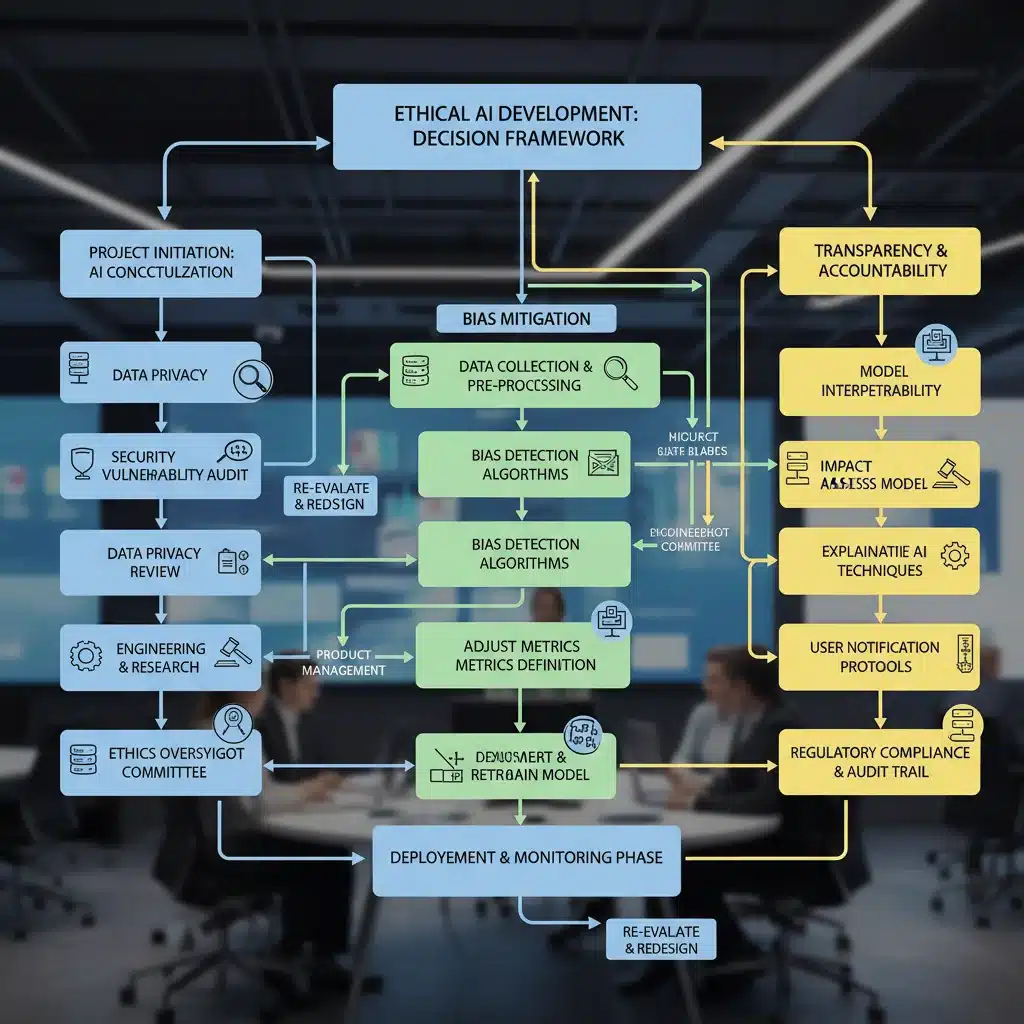
2. Integrate Ethics into the AI Lifecycle
Ethical considerations should not be an afterthought. They must be woven into every stage of the AI development lifecycle:
- Problem Definition: Question whether AI is the appropriate solution and assess potential societal impacts.
- Data Collection & Preparation: Ensure data is representative, unbiased, ethically sourced, and privacy-compliant.
- Model Design & Training: Select algorithms with explainability in mind, and apply bias detection and mitigation techniques.
- Testing & Validation: Beyond performance metrics, test for fairness, robustness, and potential for harm across various demographic groups.
- Deployment & Monitoring: Implement continuous monitoring for drift, bias, and unexpected behaviors. Establish clear human oversight mechanisms.
3. Utilize Ethical AI Toolkits and Libraries
A growing number of open-source tools and libraries can assist developers in implementing ethical AI practices. Examples include:
- Fairness Toolkits: IBM’s AI Fairness 360, Google’s What-If Tool, Microsoft’s Fairlearn. These help detect and mitigate biases.
- Explainability Libraries: LIME, SHAP, Captum. These provide insights into model decisions.
- Privacy-Preserving AI: Libraries for differential privacy (e.g., Opacus for PyTorch) and federated learning.
Familiarizing yourself with and integrating these tools into your workflow will be crucial for demonstrating ethical diligence.
4. Establish Cross-Functional Teams
AI ethics is not solely a technical problem. It requires collaboration between developers, legal experts, ethicists, social scientists, and business stakeholders. Establishing cross-functional teams ensures a holistic perspective, bringing diverse viewpoints to identify and address ethical challenges effectively. Regular communication and shared understanding are key.
5. Implement Robust Documentation and Audit Trails
For accountability and compliance, meticulous documentation is essential. This includes:
- Detailed records of data sources, preprocessing steps, and bias mitigation efforts.
- Clear descriptions of model architecture, training parameters, and evaluation metrics, including fairness metrics.
- Documentation of human oversight procedures and intervention points.
- Records of ethical impact assessments and risk analyses.
This audit trail will be invaluable for internal reviews, external audits, and demonstrating adherence to AI ethics frameworks.
The Future of AI Ethics in the US Beyond Q1 2026
While Q1 2026 marks a significant milestone, the journey of AI ethics is continuous. The landscape will continue to evolve, with new technological advancements, unforeseen ethical dilemmas, and further regulatory refinements. US developers must adopt a mindset of continuous learning and adaptation. Future trends likely include:
- Increased Sector-Specific Regulation: Expect more detailed regulations tailored to specific industries like healthcare, finance, and autonomous vehicles.
- Global Harmonization Efforts: While the US has its unique approach, there will likely be increasing pressure for some level of alignment with international standards and frameworks (e.g., EU AI Act) to facilitate global AI deployment.
- Focus on AI in Critical Infrastructure: Enhanced scrutiny and stricter ethical guidelines for AI applications in critical infrastructure sectors due to national security and public safety concerns.
- Emphasis on AI’s Environmental Impact: Growing awareness of the energy consumption and carbon footprint of large AI models will lead to ethical considerations around sustainable AI development.
- Enhanced Public Scrutiny and Consumer Expectations: As AI becomes more ubiquitous, public awareness and expectations regarding ethical AI will rise, leading to greater demand for transparency and fairness.
Developers who build a strong foundation in current AI ethics frameworks will be better equipped to adapt to these future challenges and opportunities. Proactive engagement with ethical considerations will not only ensure compliance but also foster innovation and build public trust in AI technologies.

Conclusion: Embracing Ethical AI for a Responsible Future
The imperative for US developers to understand and integrate the latest AI ethics frameworks by Q1 2026 is clear. This isn’t merely about avoiding penalties; it’s about building a future where AI serves humanity responsibly and equitably. The fragmented but robust US landscape of executive orders, agency guidance, and state initiatives demands a proactive and comprehensive approach. By prioritizing fairness, transparency, accountability, privacy, safety, and human oversight, developers can ensure their AI systems are not only innovative but also trustworthy and beneficial.
The NIST AI RMF offers a solid foundation, while a deep understanding of algorithmic accountability, bias mitigation, and stringent data privacy practices will be non-negotiable. Practical steps like continuous education, lifecycle integration of ethics, leveraging ethical AI toolkits, fostering cross-functional collaboration, and maintaining meticulous documentation will empower developers to meet the demands of the evolving ethical AI landscape. As Q1 2026 approaches, let us embrace this opportunity to shape a responsible and ethical future for AI in the United States and beyond.