
The landscape of software development is in perpetual motion, a dynamic ecosystem where methodologies evolve to meet the ever-increasing demands of speed, quality, and adaptability. In the United States, as we look towards 2026, the emphasis on enhancing Agile Development Lifecycles has never been more pronounced. Organizations are not just adopting Agile; they are refining, customizing, and integrating it with other advanced practices to unlock unprecedented levels of efficiency and innovation. This comprehensive exploration delves into the current state, emerging trends, and strategic imperatives for optimizing Agile Development Lifecycles across the US tech sector.
Anúncios
The Evolution of Agile in the US: A 2026 Perspective
Agile, once a revolutionary concept, has matured into the de facto standard for many software development teams. However, its implementation is far from static. In 2026, US organizations are moving beyond basic Scrum or Kanban frameworks, seeking deeper integration and holistic approaches to their Agile Development Lifecycles. This evolution is driven by several factors: the need for faster time-to-market, heightened customer expectations for seamless digital experiences, the complexity of modern software systems, and the imperative for continuous innovation.
Initial Agile adoptions often focused on team-level processes. Now, the trend is towards scaling Agile across the enterprise. This involves aligning multiple Agile teams, departments, and even business units under a unified strategic vision. Frameworks like SAFe (Scaled Agile Framework), LeSS (Large-Scale Scrum), and Disciplined Agile (DA) are gaining traction as companies strive to bring Agile principles to portfolio management, budgeting, and strategic planning. The goal is to ensure that every layer of the organization contributes to and benefits from the agility inherent in the development process.
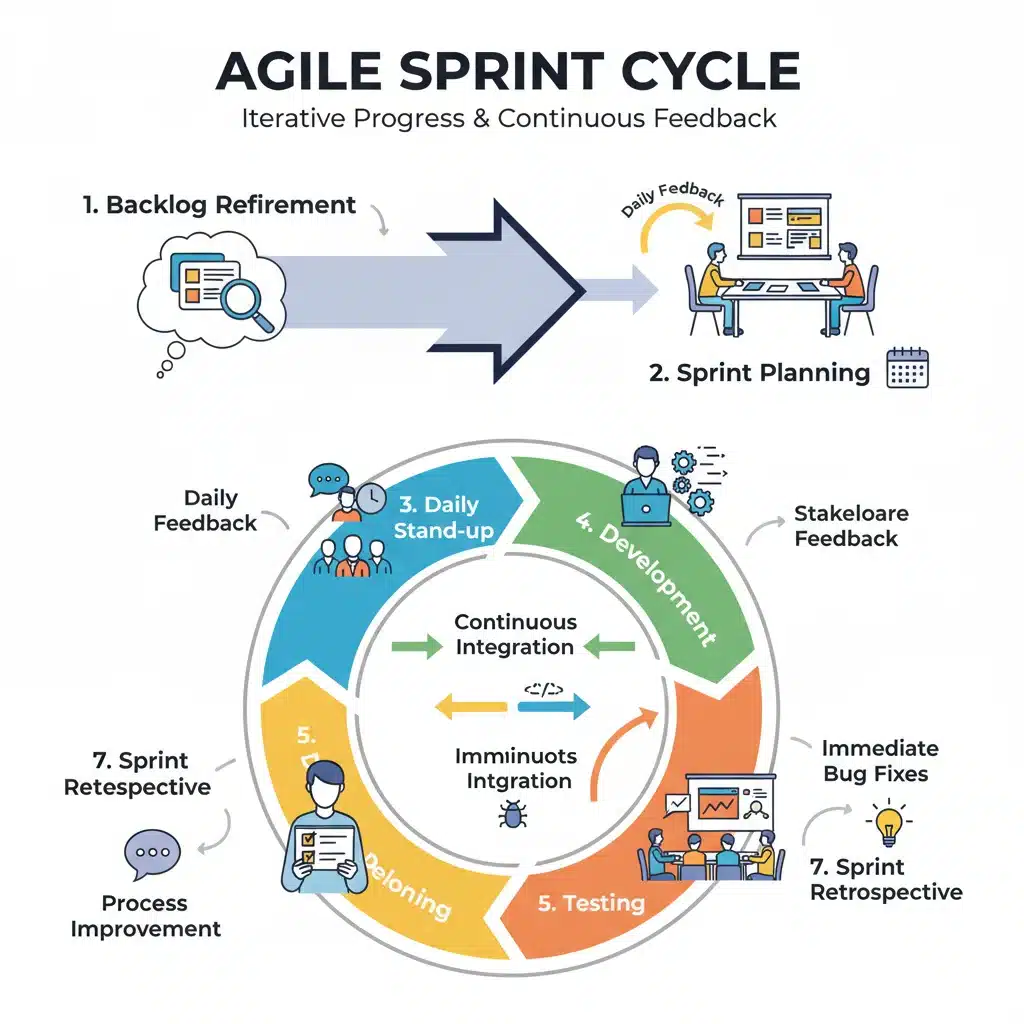
Furthermore, the concept of a ‘hybrid Agile’ approach is becoming more prevalent. This isn’t a return to Waterfall, but rather a pragmatic integration of Agile with other methodologies and practices. For instance, combining Agile sprints with robust DevOps pipelines ensures continuous integration, delivery, and deployment, drastically reducing the lead time from idea to production. Similarly, incorporating design thinking principles into the initial stages of an Agile Development Lifecycle helps to ensure that user needs are deeply understood and validated before significant development effort is expended.
Anúncios
Key Drivers for Optimizing Agile Development Lifecycles
Several critical factors are compelling US companies to continuously optimize their Agile Development Lifecycles:
1. Accelerating Time-to-Market
In today’s hyper-competitive digital economy, speed is paramount. The ability to quickly conceptualize, develop, and deploy new features or products can be a significant differentiator. Optimized Agile processes, coupled with automation and efficient feedback loops, allow organizations to respond rapidly to market changes and seize new opportunities.
2. Enhancing Product Quality and Customer Satisfaction
Agile’s iterative nature and emphasis on continuous feedback loops are inherently designed to improve product quality. By involving stakeholders and end-users throughout the development process, teams can quickly identify and address issues, ensuring that the final product truly meets user needs and expectations. This direct engagement translates into higher customer satisfaction and loyalty.
3. Fostering Innovation and Adaptability
The business environment is unpredictable. Optimized Agile Development Lifecycles provide the flexibility to pivot quickly, adapt to new requirements, and incorporate emerging technologies without disrupting the entire development process. This adaptability is crucial for staying competitive and fostering a culture of continuous innovation.
4. Improving Team Collaboration and Morale
Agile methodologies emphasize self-organizing, cross-functional teams and transparent communication. When implemented effectively, this fosters a collaborative environment where team members feel empowered, valued, and motivated. Improved collaboration not only boosts productivity but also enhances team morale and reduces burnout.
5. Cost Efficiency and Risk Mitigation
By breaking down projects into smaller, manageable iterations, Agile allows for early detection of potential problems, reducing the risk of costly rework later in the development cycle. Continuous testing and feedback loops help in identifying and mitigating technical debt and other risks proactively, leading to more cost-efficient project delivery.
Emerging Trends in US Agile Implementations for 2026
As we navigate towards 2026, several key trends are shaping the future of Agile Development Lifecycles in the US:
1. AI and Machine Learning Integration
Artificial Intelligence (AI) and Machine Learning (ML) are not just features within software; they are becoming integral tools for enhancing the development process itself. AI can optimize backlog prioritization, predict potential roadblocks, automate testing, and even assist in code generation and refactoring. ML algorithms can analyze project data to provide insights into team performance, sprint predictability, and resource allocation, making Agile processes smarter and more efficient.
2. Advanced DevOps Automation
The synergy between Agile and DevOps continues to strengthen. In 2026, we’re seeing an even greater push towards hyper-automation within DevOps pipelines. This includes advanced CI/CD (Continuous Integration/Continuous Delivery) practices, automated security scanning (DevSecOps), and infrastructure as code (IaC) to ensure that environments are consistently provisioned and managed. The goal is to achieve a truly seamless flow from development to deployment, minimizing manual intervention and human error.
3. Value Stream Management (VSM)
Organizations are increasingly adopting Value Stream Management to gain end-to-end visibility into their software delivery processes. VSM helps identify bottlenecks, eliminate waste, and optimize the flow of value from ideation to production and beyond. By mapping out the entire Agile Development Lifecycle as a value stream, companies can make data-driven decisions to improve efficiency and accelerate delivery.
4. Product-Centric vs. Project-Centric Agile
The shift from project-centric to product-centric thinking is a significant trend. Instead of focusing on delivering a series of projects with defined start and end dates, teams are organized around long-lived products, continuously evolving and improving them based on user feedback and market needs. This fosters a deeper understanding of the product vision and encourages sustained innovation, moving beyond the traditional constraints of project timelines.
5. Enhanced Metrics and Analytics for Performance
While Agile emphasizes working software over comprehensive documentation, the need for robust metrics to measure team performance and process efficiency is growing. Beyond basic sprint velocity, teams are leveraging advanced analytics to track lead time, cycle time, defect escape rates, and mean time to recovery (MTTR). These metrics provide actionable insights for continuous improvement within the Agile Development Lifecycle.
Challenges in Optimizing Agile Development Lifecycles
Despite the numerous benefits, organizations still face significant challenges in fully optimizing their Agile Development Lifecycles:
1. Cultural Resistance and Mindset Shifts
Perhaps the biggest hurdle is cultural. Agile requires a fundamental shift in mindset, moving away from command-and-control structures to empowered, self-organizing teams. Resistance from management, fear of change among employees, and a lack of understanding of Agile principles can impede successful adoption and optimization.
2. Scaling Agile Effectively
While scaling frameworks exist, implementing them successfully across a large enterprise is complex. It requires significant investment in training, process re-engineering, and continuous alignment. Maintaining consistency and communication across multiple Agile teams and business units can be a daunting task.
3. Technical Debt Management
The pressure for rapid delivery can sometimes lead to accumulating technical debt. While Agile encourages refactoring and continuous improvement, managing technical debt effectively within tight sprint cycles remains a challenge for many teams. Unaddressed technical debt can slow down future development and reduce product quality.
4. Talent Shortages and Skill Gaps
The demand for skilled Agile practitioners, Scrum Masters, product owners, and DevOps engineers continues to outpace supply. Organizations often struggle to find and retain talent with the necessary technical and soft skills to drive optimized Agile Development Lifecycles. Continuous training and upskilling are essential.
5. Measuring ROI of Agile Transformations
Quantifying the return on investment (ROI) of Agile transformations can be difficult. While qualitative benefits like improved morale and adaptability are evident, translating these into concrete financial metrics requires sophisticated tracking and analysis, which many organizations are still developing.
Best Practices for Enhancing Agile Development Lifecycles in 2026
To overcome these challenges and truly enhance Agile Development Lifecycles, US organizations should focus on several key best practices:
1. Invest in Continuous Training and Coaching
Agile is a journey, not a destination. Regular training for all team members, from developers to leadership, is crucial. This includes not just technical skills but also soft skills like communication, collaboration, and conflict resolution. Agile coaches can play a vital role in guiding teams and fostering an Agile mindset.
2. Foster a Culture of Psychological Safety
Teams thrive when members feel safe to experiment, fail, and learn without fear of blame. Leaders must actively promote psychological safety, encouraging open communication, constructive feedback, and a blame-free post-mortem culture. This is foundational for effective self-organizing Agile teams.
3. Embrace Automation and DevOps Principles
Automate everything that can be automated – testing, deployment, infrastructure provisioning, and monitoring. Integrating robust DevOps practices into the Agile Development Lifecycle is non-negotiable for achieving speed, reliability, and quality at scale. This includes implementing continuous integration, continuous delivery, and continuous deployment (CI/CD).
4. Prioritize Value Stream Mapping and Optimization
Regularly map out and analyze your value streams to identify and eliminate waste. Understanding the flow of value from end-to-end helps in optimizing processes, reducing lead times, and ensuring that development efforts are aligned with business goals.
5. Focus on Product Ownership and User Centricity
Empower product owners with clear vision, authority, and accountability. Ensure they are deeply connected to customer needs and market trends. Continuous user feedback and validation loops are essential to build products that truly resonate with the target audience, driving the success of the Agile Development Lifecycle.
6. Implement Robust Metrics and Data-Driven Decision Making
Move beyond vanity metrics. Focus on actionable insights derived from data on lead time, cycle time, defect density, and team happiness. Use these metrics to identify areas for improvement, track progress, and make informed decisions about process adjustments.
7. Encourage Cross-Functional Collaboration Beyond Teams
While Agile teams are cross-functional, true enterprise agility requires collaboration across different departments, including marketing, sales, legal, and operations. Breaking down organizational silos is crucial for end-to-end value delivery.
The Future of Agile in the US: Beyond 2026
Looking beyond 2026, the trajectory for Agile Development Lifecycles in the US points towards even greater sophistication and integration. We can anticipate:
- Hyper-Personalized Agile Frameworks: Organizations will increasingly tailor Agile frameworks to their unique cultural context, industry, and specific project needs, moving away from one-size-fits-all solutions.
- AI-Driven Agile Coaching: AI tools will augment human Agile coaches, providing real-time feedback, predictive analytics for sprint planning, and personalized recommendations for team improvement.
- Quantum-Enhanced Development: While still nascent, quantum computing’s potential to solve complex optimization problems could revolutionize how backlogs are prioritized and how resource allocation is managed in future Agile Development Lifecycles.
- Sustainability in Software Development: As environmental concerns grow, Agile practices will incorporate principles of ‘green coding’ and sustainable software engineering, optimizing resource usage and energy consumption throughout the development and operational phases.
- Ethical AI and Responsible Development: With the rise of AI, ethical considerations will be paramount. Agile teams will increasingly integrate ethical design principles and responsible AI guidelines into their development processes, ensuring fairness, transparency, and accountability.
Conclusion
Enhancing Agile Development Lifecycles is an ongoing journey that demands continuous learning, adaptation, and investment. In the US, as we look to 2026 and beyond, the focus is squarely on integrating advanced technologies like AI and robust DevOps, adopting value stream management, and fostering a deep product-centric culture. While challenges persist, the organizations that commit to these strategic imperatives – prioritizing people, processes, and technology – will be best positioned to innovate rapidly, deliver exceptional value to their customers, and maintain a competitive edge in the dynamic world of software development. The future of software is agile, and its continuous evolution is a testament to its enduring power to transform how we build and deliver technology.