Cloud Migration 2026: 6-Month Roadmap for Mid-Sized Enterprises to Cut IT Costs by 20%

Anúncios
Cloud Migration 2026: A 6-Month Roadmap for Mid-Sized Enterprises to Reduce IT Costs by 20%
In the rapidly evolving digital landscape, mid-sized enterprises face a crucial imperative: innovate or be left behind. The promise of cloud computing, particularly its potential to significantly reduce IT costs while boosting agility and scalability, is no longer a futuristic concept but a present-day necessity. As we look towards 2026, the strategic adoption of cloud technologies becomes paramount for competitive advantage. This article presents a comprehensive cloud migration roadmap, specifically tailored for mid-sized enterprises, designed to achieve a remarkable 20% reduction in IT costs within a focused six-month timeframe.
The journey to the cloud can seem daunting, filled with technical complexities, security concerns, and the fear of disrupting existing operations. However, with a clear, phased approach, even enterprises with limited in-house cloud expertise can successfully navigate this transformation. Our cloud migration roadmap emphasizes meticulous planning, iterative execution, and continuous optimization, ensuring that the transition is smooth, cost-effective, and delivers tangible business benefits.
Anúncios
Why target a 20% cost reduction? For mid-sized enterprises, every percentage point of savings in IT can be reinvested into innovation, market expansion, or talent acquisition, directly impacting the bottom line and long-term growth. By 2026, organizations that have strategically embraced cloud migration will be better positioned to adapt to market shifts, scale operations efficiently, and leverage advanced technologies like AI and machine learning, which are often cloud-native.
Understanding the Strategic Imperative: Why Cloud Migration Now?
The decision to undertake a cloud migration is more than just an IT project; it’s a strategic business decision. For mid-sized enterprises, the drivers for this transformation are often multifaceted:
Anúncios
- Cost Efficiency: Moving from a CapEx model (on-premise infrastructure) to an OpEx model (cloud services) can significantly reduce upfront investments and ongoing maintenance costs. Pay-as-you-go pricing, optimized resource utilization, and reduced need for physical hardware are major contributors to savings.
- Scalability and Flexibility: Cloud environments offer unparalleled elasticity, allowing businesses to scale resources up or down rapidly based on demand. This agility is crucial for handling peak loads, rapid growth, or unexpected market changes without over-provisioning.
- Enhanced Security and Compliance: Leading cloud providers invest heavily in security infrastructure and compliance certifications, often surpassing what individual mid-sized enterprises can achieve in-house. While shared responsibility models exist, the underlying security of the cloud platform is robust.
- Innovation and Modernization: The cloud provides access to a vast ecosystem of services, including advanced analytics, machine learning, IoT, and serverless computing. This enables quicker development cycles, faster deployment of new features, and the ability to innovate at an accelerated pace.
- Business Continuity and Disaster Recovery: Cloud-based disaster recovery solutions offer superior resilience and faster recovery times compared to traditional on-premise setups, ensuring business continuity even in the face of unforeseen events.
- Remote Work Enablement: The shift to remote and hybrid work models has underscored the importance of accessible, secure, and scalable cloud infrastructure for collaboration and productivity.
A well-executed cloud migration roadmap not only addresses these drivers but also sets the foundation for future digital transformation initiatives, ensuring that your enterprise remains competitive and resilient through 2026 and beyond.
The 6-Month Cloud Migration Roadmap: A Phased Approach
Our proposed cloud migration roadmap is structured into six distinct phases, each spanning approximately one month. This phased approach allows for manageable steps, continuous evaluation, and the flexibility to adapt as needed.
Phase 1: Assessment and Strategic Planning (Month 1)
This foundational phase is critical for the success of your entire cloud migration. It involves a deep dive into your current IT landscape and the formulation of a clear strategy.
Key Activities:
- Inventory and Discovery: Catalog all existing applications, databases, servers, network infrastructure, and dependencies. Understand their current performance, resource utilization, and interconnections.
- Application Rationalization (The 6 Rs): Evaluate each application using the ‘6 Rs’ framework: Rehost (lift-and-shift), Refactor (re-architect for cloud-native features), Revise (modify existing code), Rebuild (re-architect from scratch), Replace (switch to SaaS), or Retire (decommission). This helps determine the most suitable migration strategy for each workload.
- Cost Analysis and Business Case Development: Conduct a detailed Total Cost of Ownership (TCO) analysis comparing current on-premise costs with projected cloud costs. Quantify the potential 20% cost reduction by 2026 and build a compelling business case for stakeholders.
- Cloud Provider Selection: Based on your requirements (e.g., specific services, compliance needs, geographical presence, pricing models), choose the most appropriate cloud provider(s) – AWS, Azure, Google Cloud, or a hybrid/multi-cloud approach.
- Team Training and Skill Development: Identify skill gaps within your IT team and initiate training programs for cloud architecture, operations, and security. Consider external consultants if necessary.
- Establish Governance and Security Policies: Define cloud governance frameworks, security policies, access controls, and compliance requirements from the outset.
- Pilot Project Identification: Select a low-risk, non-critical application or workload for an initial pilot migration. This will serve as a learning experience without impacting core business operations.
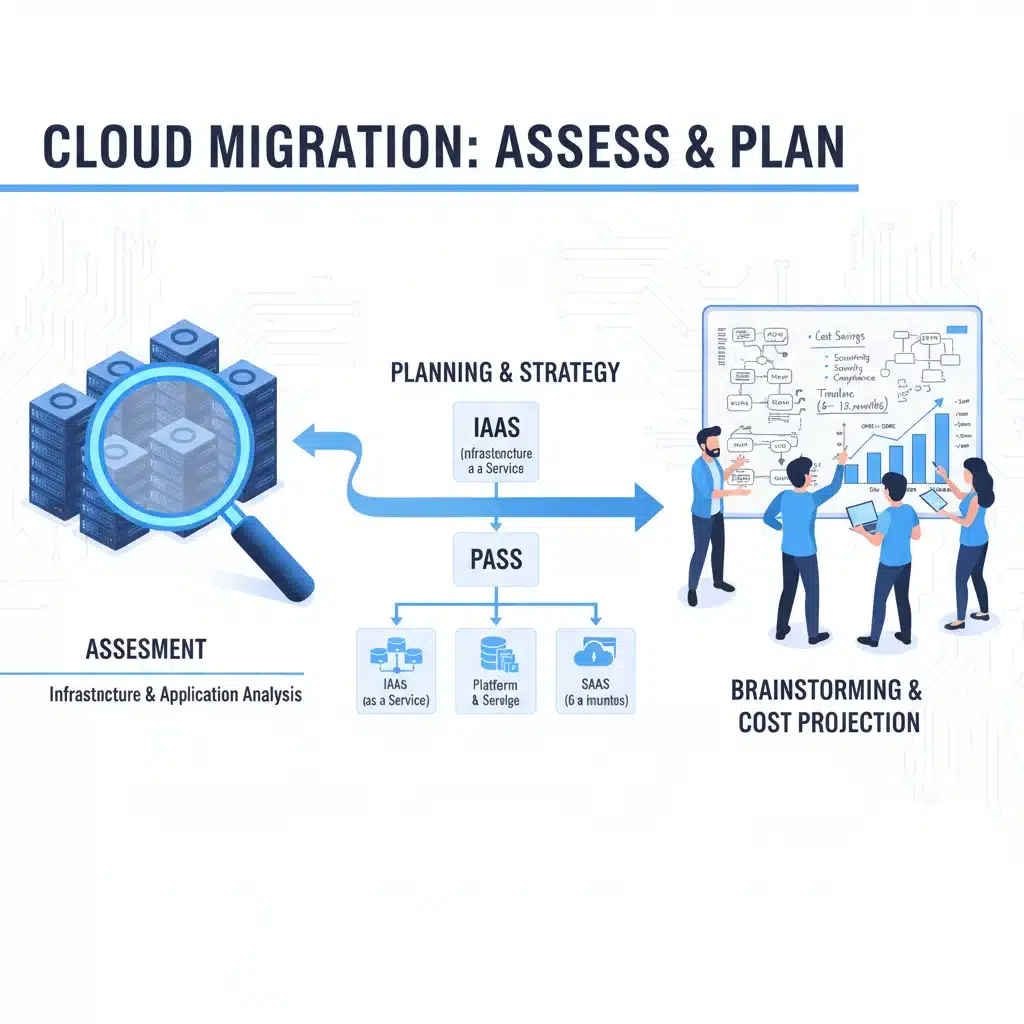
Success Metric for Month 1: A documented cloud migration strategy, TCO analysis with projected savings, selected cloud provider, and a defined pilot project.
Phase 2: Foundation and Pilot Migration (Month 2)
With a solid plan in place, this phase focuses on establishing the basic cloud infrastructure and executing your first migration.
Key Activities:
- Cloud Environment Setup: Configure virtual networks, subnets, identity and access management (IAM), security groups, and other foundational services in your chosen cloud environment.
- Tooling and Automation Setup: Implement migration tools, monitoring solutions, configuration management, and automation scripts to streamline future migrations and operations.
- Data Migration Strategy: Plan how data will be moved to the cloud, considering data volume, latency, security, and integrity. This might involve database migration services, storage gateways, or direct transfers.
- Pilot Project Execution: Migrate the identified pilot application. Document every step, challenge, and lesson learned. This hands-on experience is invaluable for refining your cloud migration roadmap.
- Testing and Validation of Pilot: Thoroughly test the migrated pilot application for functionality, performance, security, and compliance in the cloud environment.
Success Metric for Month 2: A configured cloud foundational environment and a successfully migrated and validated pilot application.
Phase 3: Core Application Migration (Months 3-4)
This is where the bulk of the migration effort occurs, focusing on critical but less complex applications identified during the assessment phase.
Key Activities:
- Iterative Migration Waves: Group applications into logical waves based on dependencies, complexity, and business impact. Prioritize migrations that offer quick wins or significant cost savings.
- Data Migration: Execute the planned data migration strategies for each application wave. Ensure data integrity and minimal downtime.
- Application Replatforming/Refactoring (if applicable): For applications identified for replatforming or refactoring, begin the necessary code changes and architectural adjustments to leverage cloud-native services.
- Continuous Testing: Perform extensive testing post-migration for each application wave, including functional, performance, security, and user acceptance testing (UAT).
- Monitoring and Performance Tuning: Implement cloud-native monitoring tools to track application performance, resource utilization, and cost in real-time. Optimize resources to ensure efficiency.
- Decommissioning On-Premise: As applications are successfully migrated and validated, begin the process of decommissioning corresponding on-premise infrastructure to realize immediate cost savings.
Success Metric for Months 3-4: A significant portion of core applications successfully migrated, tested, and running efficiently in the cloud. Initial on-premise infrastructure decommissioned.
Phase 4: Advanced Services and Optimization (Month 5)
With core applications in the cloud, this phase focuses on leveraging advanced cloud capabilities and fine-tuning your environment for maximum benefit and cost reduction.
Key Activities:
- Cloud-Native Service Adoption: Explore and integrate advanced cloud services like serverless functions (AWS Lambda, Azure Functions), managed databases, containerization (Kubernetes), or AI/ML services to further enhance application performance, scalability, and reduce operational overhead.
- Security Hardening and Compliance Review: Conduct a thorough review of your cloud security posture. Implement advanced security measures, intrusion detection, and ensure continuous compliance with industry regulations.
- Cost Optimization Deep Dive: Utilize cloud cost management tools to identify underutilized resources, right-size instances, leverage reserved instances or spot instances, and implement auto-scaling policies. This is crucial for achieving and maintaining the 20% cost reduction target by 2026.
- Automation of Operations: Automate routine operational tasks such as backups, patching, and deployments using Infrastructure as Code (IaC) and CI/CD pipelines.
- Refining Disaster Recovery and Business Continuity: Optimize cloud-based DR solutions, conducting regular drills to ensure readiness and effectiveness.
Success Metric for Month 5: Enhanced cloud environment leveraging advanced services, robust security posture, and clear evidence of cost optimization efforts contributing to the 20% target.
Phase 5: Final Migration and Hypercare (Month 6)
The final push to migrate remaining workloads and stabilize the cloud environment, coupled with a period of intensive support.
Key Activities:
- Remaining Workload Migration: Complete the migration of any remaining applications, including those that might have been deemed more complex or lower priority initially.
- Decommissioning Legacy Systems: Fully decommission all remaining on-premise infrastructure that has been replaced by cloud services. This is a critical step for realizing the full financial benefits of cloud migration.
- Documentation and Knowledge Transfer: Ensure all cloud infrastructure, applications, and operational procedures are thoroughly documented. Conduct comprehensive knowledge transfer sessions with your internal IT team.
- Hypercare Support: Provide intensive monitoring and support for all migrated systems. Address any post-migration issues promptly and efficiently.
- Performance Baseline and Reporting: Establish new performance baselines for all cloud applications and set up regular reporting mechanisms for IT costs, resource utilization, and operational metrics.

Success Metric for Month 6: All planned workloads migrated, legacy systems decommissioned, stable cloud operations, and documented proof of achieving or being on track for the 20% IT cost reduction by 2026.
Key Considerations for a Successful Cloud Migration
Beyond the phased cloud migration roadmap, several critical factors influence the success of your journey:
People and Culture
- Change Management: Cloud migration represents a significant shift in how IT operates. Effective change management is crucial to get employee buy-in and address potential resistance.
- Skill Development: Invest continuously in training your IT team. Cloud technologies evolve rapidly, and ongoing learning is essential.
- Cross-Functional Collaboration: Foster collaboration between IT, finance, and business units to ensure alignment on goals and benefits.
Security and Compliance
- Shared Responsibility Model: Understand the shared responsibility model in cloud computing, where the cloud provider manages security of the cloud, and the customer is responsible for security in the cloud.
- Data Governance: Implement robust data governance policies, including data residency, encryption, and access controls.
- Regular Audits: Conduct regular security audits and compliance checks to ensure adherence to standards.
Cost Management and Optimization
- FinOps Practices: Adopt FinOps (Cloud Financial Operations) principles to bring financial accountability to the variable spend model of cloud. This involves collaboration between finance, business, and technology teams.
- Continuous Monitoring: Implement continuous monitoring of cloud spending to identify anomalies and optimization opportunities.
- Reserved Instances/Savings Plans: Leverage pricing models like Reserved Instances (RIs) or Savings Plans for predictable workloads to achieve significant discounts.
- Right-Sizing: Regularly review and right-size your cloud resources to match actual usage, avoiding over-provisioning.
Vendor Management
- SLAs and Support: Clearly understand the Service Level Agreements (SLAs) and support options provided by your cloud vendor.
- Cost Negotiation: Don’t hesitate to negotiate pricing, especially as your cloud consumption grows.
- Multi-Cloud Strategy: Consider a multi-cloud approach to avoid vendor lock-in and leverage best-of-breed services from different providers.
Measuring Success: Beyond the 20% Cost Reduction
While the 20% IT cost reduction by 2026 is a primary goal of this cloud migration roadmap, true success encompasses more than just financial savings. Enterprises should also track:
- Operational Efficiency: Reduced incident rates, faster deployment times, improved resource utilization.
- Business Agility: Quicker time-to-market for new products and services, faster response to market changes.
- Employee Productivity: Enhanced collaboration tools, reduced time spent on infrastructure maintenance.
- Security Posture: Improved compliance scores, fewer security incidents.
- Innovation Capacity: The ability to experiment with new technologies and develop innovative solutions.
Regularly review these metrics to demonstrate the holistic value of your cloud migration and ensure continuous improvement.
Challenges and How to Overcome Them
No cloud migration roadmap is without its hurdles. Mid-sized enterprises might encounter:
- Legacy System Complexity: Older applications with tight dependencies can be challenging to move. A thorough assessment (Phase 1) is key to identifying and planning for these.
- Data Gravity: Large datasets can be difficult and time-consuming to migrate. Strategic data migration planning and the use of specialized services are crucial.
- Security and Compliance Concerns: Misconceptions or real challenges regarding data security and regulatory compliance need to be addressed proactively with robust policies and expert guidance.
- Vendor Lock-in: Over-reliance on a single cloud provider’s proprietary services can make future transitions difficult. A well-thought-out architecture and potentially a multi-cloud strategy can mitigate this.
- Skill Gap: Lack of in-house cloud expertise can slow down migration. Investing in training and leveraging external expertise can bridge this gap.
- Unexpected Costs: Without proper planning and continuous monitoring, cloud costs can escalate. FinOps practices and diligent cost optimization are vital.
By anticipating these challenges and integrating solutions into your cloud migration roadmap, mid-sized enterprises can navigate the journey more smoothly.
Conclusion: Your Path to a Leaner, More Agile Future by 2026
The six-month cloud migration roadmap presented here offers a structured, achievable path for mid-sized enterprises to significantly reduce IT costs by 20% by 2026, while simultaneously enhancing operational efficiency, security, and innovation capabilities. This journey is not merely about shifting infrastructure; it’s about transforming your business to be more agile, resilient, and competitive in the digital age.
By committing to a meticulous assessment, a phased migration, continuous optimization, and a culture of learning, your enterprise can successfully harness the power of the cloud. The investment in this transformation will pay dividends not only in cost savings but also in the ability to adapt, innovate, and thrive in an increasingly cloud-centric world. Start planning your cloud migration today to secure a more efficient and future-proof enterprise by 2026.