Low-Code/No-Code Integration: Accelerate App Development 50% by 2026

Anúncios
Integrating Low-Code/No-Code Platforms: Insider Knowledge to Accelerate Application Development by 50% for US Enterprises in 2026
Anúncios
In the rapidly evolving landscape of digital transformation, US enterprises are constantly seeking innovative ways to enhance efficiency, reduce costs, and accelerate time-to-market for new applications. The promise of low-code and no-code (LCNC) platforms has emerged as a beacon of hope, offering a paradigm shift in how software is developed. However, the true power of these platforms isn’t just in their individual capabilities, but in their seamless integration within existing IT ecosystems. This article delves deep into the critical strategies and insider knowledge required for successful Low-Code No-Code Integration, aiming to accelerate application development by a staggering 50% for US enterprises by 2026.
The imperative for speed and agility in application development has never been greater. Traditional development cycles, often characterized by lengthy coding processes, complex infrastructure management, and significant resource allocation, are proving insufficient to meet the demands of today’s dynamic business environment. LCNC platforms address these challenges head-on by democratizing application development, empowering both professional developers and citizen developers to build sophisticated applications with minimal to no coding. Yet, without a robust Low-Code No-Code Integration strategy, these platforms risk becoming isolated silos, unable to leverage the vast data and functionalities residing within an enterprise’s existing systems. This piece will explore the multifaceted aspects of integration, from understanding its necessity to implementing best practices and navigating potential pitfalls, providing a comprehensive roadmap for US enterprises.
The Rise of Low-Code and No-Code: A Game Changer for US Enterprises
The market for LCNC platforms is experiencing explosive growth. Analysts predict that by 2026, over 70% of new applications developed by enterprises will use low-code or no-code technologies. This surge is driven by several factors: the persistent shortage of skilled developers, the increasing demand for custom applications, and the need for businesses to respond quickly to market changes. LCNC platforms offer intuitive visual interfaces, drag-and-drop functionalities, and pre-built components, significantly reducing the time and effort required to build and deploy applications. For US enterprises, this means the ability to rapidly prototype, test, and launch solutions that address specific business needs, from automating internal workflows to creating customer-facing portals.
Anúncios
However, the value proposition extends beyond mere speed. LCNC platforms foster greater collaboration between business units and IT departments. Citizen developers, who possess deep domain knowledge but may lack coding expertise, can now actively participate in the development process, ensuring that applications truly meet business requirements. This collaborative approach not only accelerates development but also improves the relevance and usability of the final product. The strategic adoption of LCNC, therefore, is not just about technology; it’s about transforming organizational culture and empowering a broader range of employees to contribute to digital innovation. The success hinges on effective Low-Code No-Code Integration with established enterprise systems.
Why Low-Code No-Code Integration is Non-Negotiable for Accelerated Development
While standalone LCNC applications can provide immediate benefits for specific use cases, their full potential is unlocked only when they are seamlessly integrated with an enterprise’s existing IT infrastructure. Imagine a new customer onboarding application built with a no-code platform. If it cannot connect to the CRM system to retrieve customer data, the ERP for billing information, or the marketing automation platform for communication, its utility is severely limited. Effective Low-Code No-Code Integration ensures that these new applications can:
- Access and leverage existing data: Avoid data silos and ensure a single source of truth across the organization.
- Automate end-to-end processes: Connect different stages of a workflow, eliminating manual handoffs and reducing errors.
- Enhance existing systems: Extend the functionality of legacy systems without costly and time-consuming custom development.
- Improve user experience: Provide a unified and consistent experience for users, regardless of the underlying platform.
- Ensure compliance and security: Integrate with existing identity and access management (IAM) systems and adhere to enterprise security policies.
Without robust integration, LCNC platforms can inadvertently create more complexity, leading to fragmented data, inefficient workflows, and a disjointed user experience. This defeats the very purpose of adopting these agile tools. Therefore, any enterprise embarking on an LCNC journey must prioritize a comprehensive Low-Code No-Code Integration strategy from the outset.
Key Challenges in Low-Code No-Code Integration and How to Overcome Them
Despite the immense benefits, integrating LCNC platforms presents its own set of challenges. Understanding these hurdles and developing proactive strategies to overcome them is crucial for success.
1. Data Silos and Inconsistent Data Formats
One of the primary challenges is connecting disparate data sources that often reside in various formats and systems (databases, legacy applications, cloud services). LCNC platforms often have their own data models, which can lead to inconsistencies if not properly managed. To address this, enterprises need to invest in robust data integration tools (ETL, iPaaS) and establish clear data governance policies. Standardizing data formats and using APIs for data exchange are essential steps.
2. Security and Compliance Concerns
Integrating new LCNC applications with core enterprise systems can introduce new security vulnerabilities if not handled correctly. Data privacy regulations (e.g., CCPA, HIPAA for US enterprises) add another layer of complexity. It’s critical to ensure that LCNC platforms and their integrations comply with all relevant security standards and regulatory requirements. This involves implementing strong authentication and authorization mechanisms, encrypting data in transit and at rest, and conducting regular security audits. Integrating LCNC platforms with existing identity and access management (IAM) solutions is a best practice.
3. Performance and Scalability Issues
As LCNC applications grow in complexity and user base, performance and scalability can become a concern, especially when interacting with backend systems. Poorly designed integrations can lead to bottlenecks and slow response times. Enterprises must ensure that their integration architecture is designed for scalability, using asynchronous communication patterns, caching mechanisms, and load balancing where appropriate. Performance testing of integrated solutions is vital before full deployment.
4. Vendor Lock-in and Interoperability
The LCNC market is diverse, with many vendors offering specialized platforms. Enterprises often use multiple LCNC tools for different needs. This can lead to vendor lock-in and interoperability challenges if integrations are not designed with flexibility in mind. Adopting open standards, using APIs, and choosing platforms that support a wide range of connectors can mitigate this risk. A strategic approach to Low-Code No-Code Integration involves building a flexible integration layer that can adapt to different platforms.
5. Complexity of Legacy System Integration
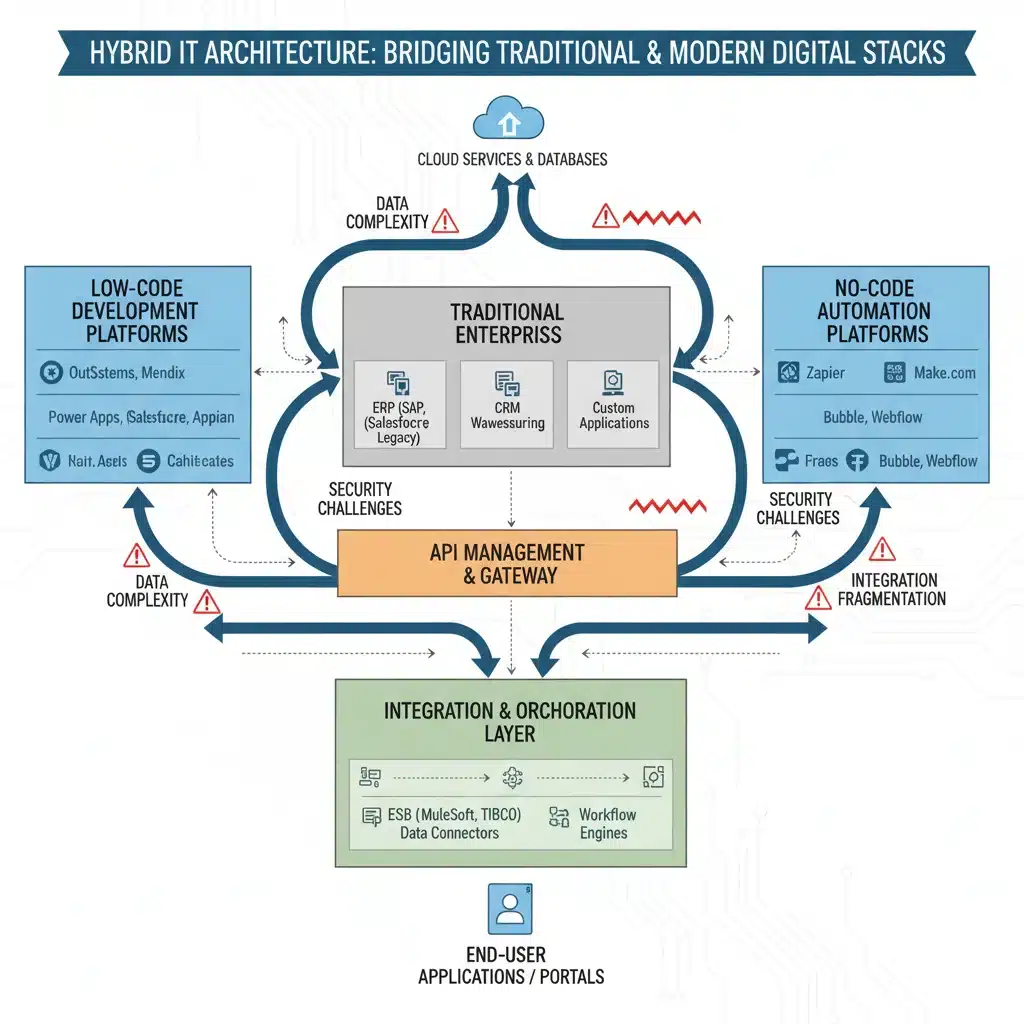
Many US enterprises rely heavily on legacy systems that are critical to their operations but can be challenging to integrate due to their age, proprietary technologies, or lack of modern APIs. Integrating LCNC platforms with these systems often requires specialized connectors, middleware, or even custom development to expose necessary functionalities. This is where a hybrid integration platform (HIP) approach, combining traditional integration methods with modern API-led connectivity, becomes invaluable.
Strategic Approaches to Low-Code No-Code Integration
Achieving a 50% acceleration in application development requires more than just adopting LCNC tools; it demands a strategic, well-planned approach to integration. Here are key strategies for US enterprises:
1. Embrace an API-First Integration Strategy
APIs (Application Programming Interfaces) are the backbone of modern integration. An API-first strategy involves exposing the functionalities of existing systems and LCNC applications through well-defined APIs. This standardizes how different systems communicate, making it easier to build new integrations and reuse existing ones. Many LCNC platforms are inherently API-driven, making this a natural fit. Enterprises should invest in API management tools to design, secure, and monitor their APIs effectively.
2. Leverage Integration Platform as a Service (iPaaS)
iPaaS solutions provide a cloud-based platform for connecting applications, data, and processes across hybrid IT environments. They offer pre-built connectors for a wide range of applications (SaaS, on-premises, LCNC platforms), visual mapping tools, and powerful orchestration capabilities. iPaaS significantly simplifies the complexity of Low-Code No-Code Integration, accelerates development cycles, and provides centralized management and monitoring of all integrations. For US enterprises with diverse IT landscapes, iPaaS is a critical enabler.
3. Implement a Hybrid Integration Platform (HIP)
Given that most US enterprises operate in a hybrid IT environment (a mix of on-premises legacy systems and cloud-based applications), a Hybrid Integration Platform (HIP) is often the most suitable approach. A HIP combines various integration technologies, including iPaaS, API management, message queuing, and enterprise service bus (ESB) capabilities, to provide a unified integration fabric. This allows for seamless connectivity between LCNC applications, cloud services, and traditional on-premises systems, ensuring flexibility and scalability.
4. Establish a Center of Excellence (CoE) for LCNC and Integration
To ensure consistent best practices, governance, and support for LCNC initiatives and their integrations, US enterprises should establish a Center of Excellence (CoE). A CoE brings together experts from IT, business units, and security to define standards, provide training, manage a library of reusable components and integrations, and oversee the overall LCNC strategy. This centralized approach fosters knowledge sharing and prevents the proliferation of unmanaged or insecure integrations.
5. Prioritize Data Governance and Security from Day One
Data integrity and security are paramount. As LCNC applications proliferate and integrate with core systems, a robust data governance framework becomes indispensable. This includes defining data ownership, quality standards, access controls, and compliance policies. Integrating LCNC platforms with existing security infrastructure (e.g., SSO, MFA, data loss prevention tools) is not an afterthought but a foundational requirement. Regular security audits and penetration testing of integrated LCNC applications should be standard practice.
Best Practices for Implementing Low-Code No-Code Integration
Beyond strategic approaches, specific best practices can significantly enhance the success rate of Low-Code No-Code Integration projects:
- Start Small, Think Big: Begin with pilot projects that have clear business objectives and manageable scope. This allows teams to gain experience, refine processes, and demonstrate value before scaling up. However, always design integrations with the broader enterprise architecture in mind to avoid creating new silos.
- Design for Reusability: Create reusable integration components, APIs, and templates. This accelerates future development efforts and ensures consistency across applications. A well-maintained library of reusable assets is a hallmark of an efficient integration strategy.
- Automate Testing: Manual testing of integrated LCNC applications can be time-consuming and error-prone. Implement automated testing frameworks to validate integrations, ensuring data accuracy, performance, and security. Continuous integration/continuous deployment (CI/CD) pipelines should include automated integration tests.
- Monitor and Manage Integrations: Implement robust monitoring tools to track the health, performance, and security of all integrations. Proactive monitoring allows for early detection and resolution of issues, minimizing downtime and impact on business operations. An iPaaS often provides these capabilities out-of-the-box.
- Foster Collaboration Between IT and Business: Successful Low-Code No-Code Integration requires close collaboration. IT provides the foundational infrastructure, security, and governance, while business users contribute domain expertise and drive application requirements. Regular communication and shared understanding are crucial.
- Document Everything: Comprehensive documentation of integration points, data flows, API specifications, and architectural decisions is vital for maintenance, troubleshooting, and onboarding new team members.
The Impact of Low-Code No-Code Integration on US Enterprises by 2026
By effectively implementing Low-Code No-Code Integration strategies, US enterprises can expect to see profound transformations by 2026:
1. Accelerated Time-to-Market:
The primary goal – a 50% acceleration in application development – becomes achievable. This means businesses can respond to market changes, launch new products, and optimize internal processes at an unprecedented pace, gaining a significant competitive edge.
2. Enhanced Business Agility:
The ability to rapidly build and modify applications allows enterprises to be more agile, adapting quickly to new customer demands, regulatory changes, and economic shifts. This agility is crucial for navigating an increasingly unpredictable global market.
3. Reduced IT Backlog:
With citizen developers contributing to application development and professional developers focusing on complex integrations and core systems, the perennial IT backlog can be significantly reduced. This frees up valuable IT resources for strategic initiatives.
4. Improved Operational Efficiency:
Seamless integration of LCNC applications with existing systems leads to end-to-end process automation, eliminating manual tasks, reducing errors, and improving overall operational efficiency across departments.
5. Greater Innovation Capacity:
By lowering the barrier to entry for application development, enterprises can foster a culture of innovation. Employees across the organization are empowered to experiment with new ideas, build custom solutions, and contribute to digital transformation efforts.
6. Optimized Resource Utilization:
LCNC platforms, especially when integrated properly, allow for better utilization of both human and technological resources. Development costs can be reduced, and existing infrastructure can be extended rather than replaced, leading to significant ROI.

Real-World Examples and Case Studies
Numerous US enterprises are already reaping the benefits of strategic Low-Code No-Code Integration. For instance, a large financial services firm used an LCNC platform integrated with their legacy mainframe systems to build a new customer self-service portal in a fraction of the time it would have taken with traditional coding. This integration allowed customers to access real-time account information and perform transactions, significantly improving customer satisfaction and reducing call center volumes.
Another example comes from a manufacturing company that integrated an LCNC-developed supply chain management application with their ERP and IoT devices. This provided real-time visibility into inventory levels, production schedules, and logistics, leading to optimized operations and substantial cost savings. These examples underscore the transformative power of well-executed Low-Code No-Code Integration.
The Future Landscape: AI and Hyperautomation in Low-Code No-Code Integration
Looking beyond 2026, the evolution of LCNC platforms and their integration capabilities will be heavily influenced by advancements in artificial intelligence (AI) and hyperautomation. AI will increasingly be embedded within LCNC platforms to assist with application design, code generation (for low-code), and intelligent automation of workflows. This will further accelerate development and enhance the sophistication of applications built by citizen and professional developers alike.
Hyperautomation, which combines various advanced technologies like AI, machine learning, robotic process automation (RPA), and intelligent business process management (iBPMS), will drive even more seamless and intelligent integration. LCNC platforms will become central orchestrators in hyperautomated environments, enabling enterprises to automate virtually every process, from simple data entry to complex decision-making, across their entire digital estate. This future will demand even more sophisticated Low-Code No-Code Integration strategies, focusing on intelligent data exchange, predictive analytics, and self-optimizing workflows.
Conclusion: Charting the Course for Accelerated Development
The journey to accelerate application development by 50% for US enterprises by 2026 is ambitious but entirely achievable through strategic Low-Code No-Code Integration. It’s not merely about adopting new tools; it’s about fundamentally rethinking how applications are built, deployed, and managed within the enterprise ecosystem. By embracing an API-first approach, leveraging iPaaS and HIP solutions, establishing CoEs, and prioritizing data governance and security, businesses can unlock the full potential of LCNC platforms.
The insights shared here provide a critical roadmap for navigating the complexities of integration, transforming challenges into opportunities for innovation and growth. The future of application development is agile, collaborative, and integrated. US enterprises that strategically invest in Low-Code No-Code Integration today will be well-positioned to lead the digital frontier tomorrow, driving unprecedented efficiency, agility, and competitive advantage in the years to come.