Low-Code No-Code Platforms: Accelerating Software Development by 40%

Anúncios
Low-Code No-Code Platforms: Accelerating Software Development by 40%
In today’s fast-paced digital landscape, businesses are constantly seeking ways to innovate faster, respond to market demands with agility, and optimize operational efficiency. The traditional software development lifecycle, often characterized by lengthy coding processes, extensive testing, and significant resource allocation, can sometimes be a bottleneck to achieving these goals. This is where low-code no-code platforms emerge as transformative solutions, promising to revolutionize how applications are built and deployed.
Anúncios
The rise of low-code no-code development is not just a trend; it’s a fundamental shift in how organizations approach digital transformation. By democratizing application development, these platforms empower both professional developers and business users (often termed ‘citizen developers’) to create sophisticated software solutions with minimal to no manual coding. Industry reports project that by 2026, low-code no-code platforms will accelerate software deployment by an impressive 40%, a testament to their growing influence and effectiveness.
This comprehensive guide will delve into the intricacies of low-code no-code platforms, exploring their core concepts, the distinct advantages they offer, the challenges they present, and their profound impact on the future of software development. Whether you’re a business leader looking to drive efficiency, an IT professional seeking to optimize resources, or an aspiring developer keen on rapid prototyping, understanding the power of low-code no-code is crucial for navigating the modern digital era.
Anúncios
What Exactly Are Low-Code No-Code Platforms?
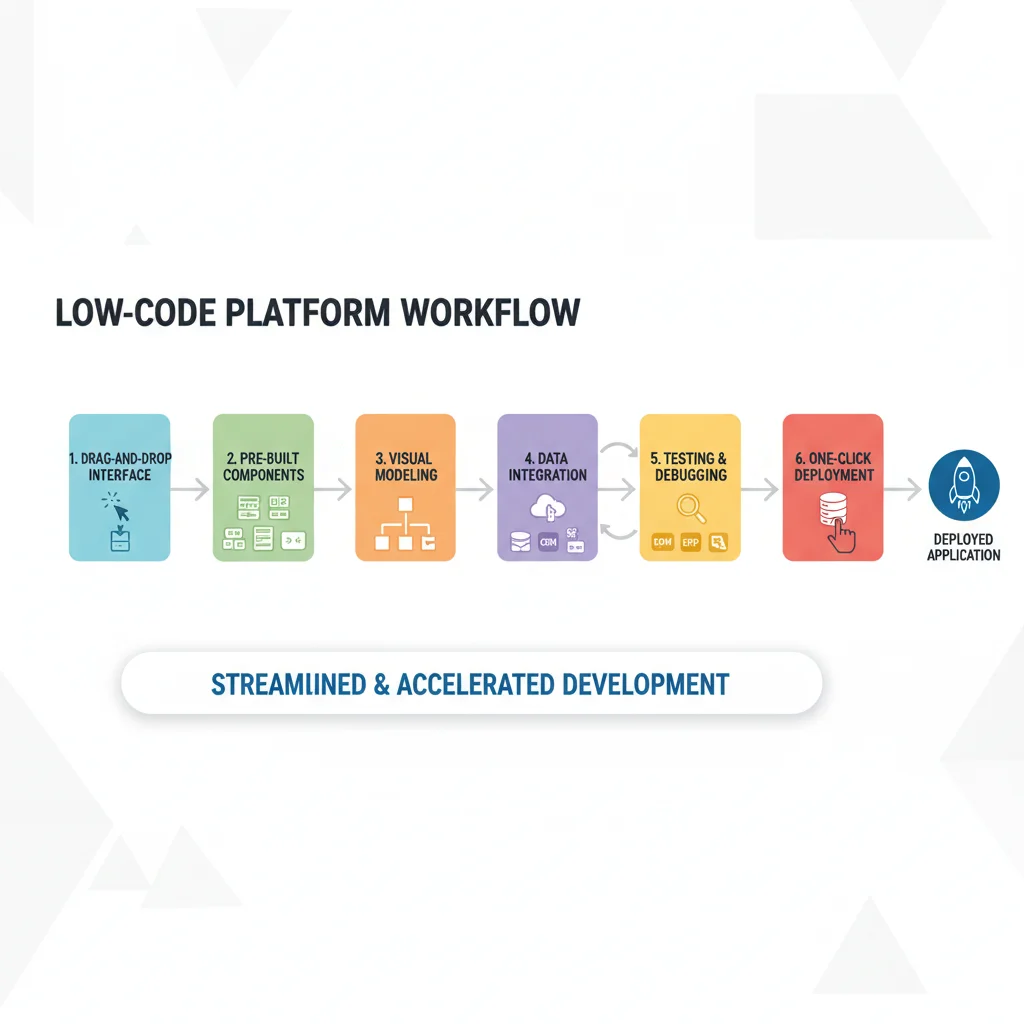
At their core, low-code no-code platforms are development environments that abstract away the complexities of traditional programming languages. They provide visual interfaces with drag-and-drop functionalities, pre-built components, and intuitive logic builders, allowing users to assemble applications rather than write lines of code from scratch.
Low-Code Platforms: Empowering Developers and Accelerating Delivery
Low-code platforms are designed to significantly reduce the amount of manual coding required to build applications. They cater primarily to professional developers and IT teams, providing a visual development environment where they can rapidly assemble applications using pre-built modules, templates, and connectors. While they minimize coding, they still offer the flexibility for developers to inject custom code when specific functionalities or integrations are needed. This hybrid approach allows for faster development cycles without sacrificing the ability to create complex, enterprise-grade applications. Think of it as providing a robust framework and a rich library of components that accelerate the initial build, allowing developers to focus their coding efforts on unique, differentiating features.
The primary goal of low-code is to enhance developer productivity, enabling them to deliver more applications in less time. This means businesses can respond to market changes more quickly, launch new products faster, and iterate on existing solutions with greater agility. It’s about optimizing the development process for speed and efficiency while maintaining the power and flexibility that professional developers require.
No-Code Platforms: Democratizing Application Development for Everyone
No-code platforms take the abstraction a step further, aiming to eliminate coding entirely. These platforms are built with business users, domain experts, and ‘citizen developers’ in mind – individuals who have deep insights into business needs but may lack traditional programming skills. No-code tools provide highly intuitive, visual interfaces that allow users to build fully functional applications, websites, and workflows using drag-and-drop editors, pre-configured templates, and declarative logic. The underlying code is automatically generated by the platform, making the entire development process accessible to non-technical users.
The promise of no-code is to democratize application creation, empowering anyone within an organization to build solutions that address their specific pain points or automate their daily tasks. This significantly reduces the reliance on IT departments for every new application request, freeing up professional developers to focus on more complex, strategic projects. No-code solutions are ideal for rapid prototyping, building internal tools, automating workflows, and creating simple customer-facing applications.
Key Benefits of Adopting Low-Code No-Code Solutions
The widespread adoption of low-code no-code platforms is driven by a compelling set of advantages that address many of the challenges faced by modern businesses.
1. Accelerated Development and Deployment
Perhaps the most significant benefit is the dramatic increase in development speed. By leveraging visual interfaces, pre-built components, and automated processes, applications can be built and deployed in a fraction of the time it would take with traditional coding. This rapid development cycle means businesses can bring ideas to market faster, respond to competitive pressures more effectively, and iterate on feedback quickly. This acceleration is a key driver behind the projected 40% faster software deployment by 2026.
2. Reduced Costs and Increased ROI
Faster development directly translates to lower development costs. Less time spent coding means fewer developer hours, reduced resource allocation, and quicker time-to-value. Furthermore, the ability to involve citizen developers in the creation process can alleviate the strain on expensive professional developer resources. This cost efficiency, combined with the ability to rapidly deploy solutions that drive business value, leads to a significantly higher return on investment (ROI).
3. Enhanced Agility and Flexibility
In today’s dynamic business environment, agility is paramount. Low-code no-code platforms enable organizations to quickly adapt to changing business requirements, market shifts, and customer needs. Modifying existing applications or building new ones becomes a much simpler and faster process, allowing businesses to remain flexible and responsive. This adaptability is crucial for maintaining a competitive edge.
4. Bridging the IT Skills Gap
The global shortage of skilled software developers is a persistent challenge for many organizations. Low-code no-code platforms help bridge this gap by enabling non-technical business users to create applications, thereby offloading some of the development burden from IT teams. This empowerment of citizen developers expands the pool of individuals who can contribute to digital innovation within an organization, making development more accessible.
5. Improved Collaboration Between Business and IT
By providing a common visual language, low-code no-code platforms foster better collaboration. Business users can directly participate in the application design and development process, ensuring that the final product truly meets their needs. This reduces miscommunication and ensures alignment between business objectives and technical implementation, leading to more effective solutions.
6. Greater Innovation and Experimentation
The ease and speed of building applications with low-code no-code tools encourage experimentation. Teams can quickly prototype new ideas, test concepts, and iterate without significant investment in time or resources. This fosters a culture of innovation, allowing organizations to explore new opportunities and develop unique solutions more readily.
Common Use Cases for Low-Code No-Code Platforms
The versatility of low-code no-code platforms makes them suitable for a wide range of applications across various industries and departments.
1. Business Process Automation (BPA)
Automating repetitive tasks and streamlining workflows is a prime use case. From expense report approvals to customer onboarding processes, low-code no-code can build custom applications that automate manual steps, reduce errors, and improve operational efficiency.
2. Customer Relationship Management (CRM) Customizations
While off-the-shelf CRM solutions are powerful, businesses often have unique needs. Low-code platforms allow for extensive customization of CRM systems, building custom modules, integrating with other tools, and creating tailored user interfaces to fit specific business processes.
3. Internal Tools and Operations Applications
Many organizations rely on a myriad of internal tools for project management, HR processes, inventory tracking, and more. Low-code no-code enables the rapid creation of bespoke internal applications that precisely meet the organization’s operational requirements, often replacing outdated spreadsheets or manual systems.
4. Web and Mobile Applications
From simple informational websites to complex customer-facing mobile applications, low-code no-code platforms can be used to build responsive and engaging digital experiences for various audiences. This includes e-commerce portals, event registration apps, and customer service portals.
5. Data Collection and Reporting
Building custom forms, surveys, and data collection applications is straightforward with these platforms. They can also be used to create dashboards and reporting tools that provide real-time insights into business performance, enabling data-driven decision-making.
6. Legacy System Modernization
Many businesses struggle with outdated legacy systems. Low-code platforms can help modernize these systems by building new user interfaces, integrating with modern APIs, or creating wrapper applications that extend the functionality of older systems without a complete overhaul.
Challenges and Considerations for Adoption
While the benefits of low-code no-code are compelling, organizations should also be aware of potential challenges and considerations before full-scale adoption.
1. Governance and Security
As more users create applications, ensuring proper governance, security, and compliance becomes critical. Organizations need to establish clear policies for who can build what, how applications are deployed, and what security standards must be met. Data privacy and access control are paramount.
2. Vendor Lock-in
Choosing a low-code no-code platform means committing to a vendor’s ecosystem. Migrating applications built on one platform to another can be challenging, potentially leading to vendor lock-in. It’s crucial to evaluate platforms based on their flexibility, export capabilities, and long-term viability.
3. Scalability and Performance
While many platforms are designed for scalability, complex enterprise-grade applications with high transaction volumes or intricate integrations might push the limits of certain low-code no-code solutions. Thorough testing and understanding the platform’s capabilities are essential.
4. Integration Limitations
While platforms offer numerous connectors, some highly specialized or legacy systems might require custom integrations that could be more complex or costly to implement within a low-code no-code environment. Evaluating integration needs is a key step.
5. Over-reliance on Citizen Developers
While empowering citizen developers is a strength, an over-reliance without proper oversight can lead to ‘shadow IT’ or applications that lack robustness, scalability, or adherence to organizational standards. A balanced approach where IT collaborates with citizen developers is often best.
6. Complexity of Advanced Features
For highly unique or cutting-edge functionalities, traditional custom coding might still be necessary. Low-code no-code excels at standard business logic and common patterns, but pushing the boundaries might require professional development expertise.

The Future of Software Development: A Hybrid Approach
The trajectory of low-code no-code platforms suggests a future where software development is more inclusive, efficient, and responsive. It’s not about replacing traditional coding but rather augmenting it. The most successful organizations will likely adopt a hybrid approach, leveraging the strengths of both methodologies.
Professional Developers and Low-Code
Professional developers will increasingly use low-code platforms to accelerate the development of standard components, integrate systems, and handle the bulk of application creation. This frees them to focus on complex algorithms, innovative features, and critical system architecture that truly differentiate a business.
Citizen Developers and No-Code
Citizen developers, empowered by no-code tools, will continue to build departmental applications, automate personal workflows, and prototype solutions, thereby reducing the backlog for IT and fostering grassroots innovation. This decentralized development model can significantly boost an organization’s overall digital output.
The Fusion of AI and Low-Code No-Code
The integration of Artificial Intelligence (AI) and Machine Learning (ML) capabilities into low-code no-code platforms is a significant emerging trend. This will enable even more intelligent applications to be built with minimal effort, incorporating predictive analytics, natural language processing, and automated decision-making directly into business processes. Imagine building an AI-powered customer service chatbot or a predictive maintenance application with just a few clicks and configurations.
Emphasis on Reusability and Composability
The future will see an even greater emphasis on reusable components and composable architectures within low-code no-code ecosystems. This will allow organizations to build libraries of pre-approved, tested modules that can be quickly assembled into new applications, further accelerating development and ensuring consistency across the enterprise.
Conclusion: Embracing the Low-Code No-Code Revolution
Low-code no-code platforms are more than just tools; they represent a paradigm shift in how businesses approach digital innovation and software creation. By offering unparalleled speed, cost efficiency, and accessibility, they are empowering organizations to be more agile, responsive, and competitive in an ever-evolving market.
The projection of a 40% acceleration in software deployment by 2026 is not just an optimistic forecast; it’s a reflection of the tangible benefits these platforms deliver. While challenges exist, strategic planning, robust governance, and a clear understanding of an organization’s specific needs can mitigate risks and unlock the full potential of this transformative technology.
For businesses looking to thrive in the digital age, embracing low-code no-code is no longer an option but a strategic imperative. It’s about democratizing development, fostering innovation, and ultimately building a more agile and resilient enterprise ready to meet the demands of tomorrow.