Navigating 2026 Data Privacy Regulations: 3 Essential Steps for US Businesses

Anúncios
Navigating the New Data Privacy Regulations in 2026: 3 Compliance Steps for US Businesses
The digital age has brought unprecedented opportunities for businesses, but with great power comes great responsibility, particularly concerning customer data. As we approach 2026, the United States is poised for significant shifts in its data privacy landscape. Businesses across all sectors must proactively prepare to meet these evolving requirements. Failing to do so can result in hefty fines, reputational damage, and a loss of customer trust. This comprehensive guide will delve into the critical aspects of the upcoming US data privacy 2026 regulations and outline three indispensable compliance steps for US businesses.
Understanding the nuances of these regulations is not merely a legal obligation; it’s a strategic imperative. Consumers are increasingly aware of their data rights, and their expectations for how businesses handle their personal information are at an all-time high. A robust data privacy framework not only ensures compliance but also builds a foundation of trust with your customer base, fostering loyalty and sustainable growth. Let’s embark on this journey to demystify the future of US data privacy 2026 and equip your business with the knowledge to thrive.
Anúncios
The Evolving Landscape of US Data Privacy: What to Expect by 2026
For years, the US has operated under a patchwork of federal and state-specific data privacy laws, a stark contrast to the more unified approach seen in regions like the European Union with GDPR. However, the momentum towards a more cohesive national framework for US data privacy 2026 is undeniable. While a single, overarching federal law comparable to GDPR is still under discussion, there’s a clear trend towards stricter regulations, expanded consumer rights, and increased enforcement mechanisms at both federal and state levels. Several states have already enacted comprehensive privacy laws, such as the California Consumer Privacy Act (CCPA) and its successor, the California Privacy Rights Act (CPRA), the Virginia Consumer Data Protection Act (VCDPA), and the Colorado Privacy Act (CPA), among others. These state-level initiatives often serve as precursors or templates for broader federal discussions, indicating the direction of future legislation.
The expected changes by 2026 are likely to focus on several key areas: enhanced consumer rights regarding access, deletion, and correction of personal data; stricter consent requirements for data collection and processing; increased transparency obligations for businesses; and more robust data security mandates to prevent breaches. Furthermore, the definition of ‘personal data’ is continually broadening to include identifiers like IP addresses, cookies, and geolocation data, making it crucial for businesses to cast a wider net in their data inventory efforts. Businesses that operate nationally or internationally will need to navigate this complex web, making a standardized and adaptable approach to US data privacy 2026 compliance absolutely essential.
Anúncios
The implications for businesses are profound. From marketing strategies to IT infrastructure, nearly every aspect of operations that touches personal data will be impacted. Proactive preparation is not just advisable; it’s imperative. Waiting until new laws are fully enacted could leave businesses scrambling, leading to hurried and potentially inadequate compliance measures. The time to act is now, laying the groundwork for a seamless transition into the new regulatory era.
Step 1: Conduct a Comprehensive Data Audit and Mapping
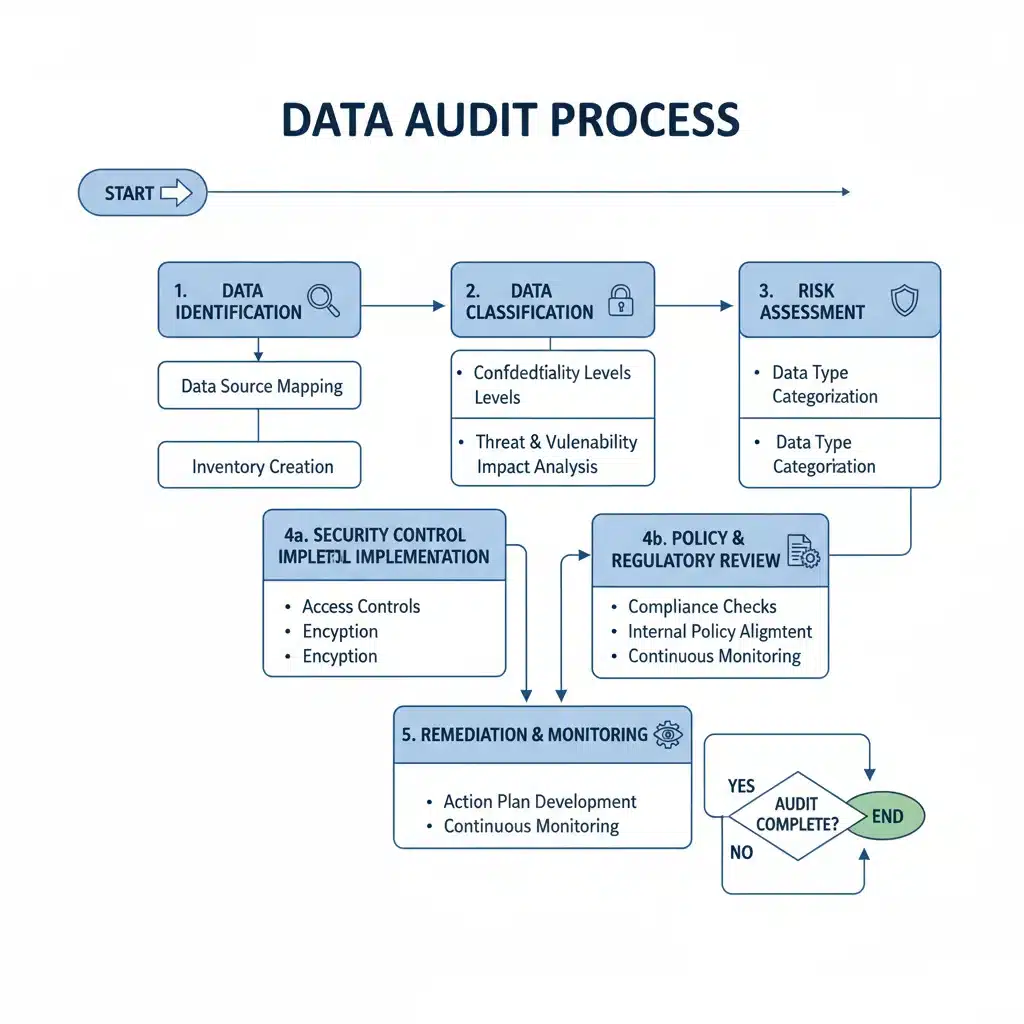
The first and arguably most critical step in preparing for US data privacy 2026 is to gain a complete understanding of the data your business collects, processes, stores, and shares. This involves conducting a thorough data audit and mapping exercise. Think of it as creating a detailed blueprint of all personal data flowing through your organization. Many businesses are often surprised by the sheer volume and variety of data they possess, much of which may be redundant, outdated, or even unnecessary for their core operations. This step is fundamental because you cannot protect what you do not know you have.
What a Data Audit Entails:
- Identify All Data Sources: Begin by cataloging every system, application, and process that collects or generates personal data. This includes websites, CRM systems, marketing automation platforms, HR databases, customer support tools, cloud storage, physical documents, and even employee devices. Be exhaustive in your search, leaving no stone unturned.
- Inventory Data Types: For each identified source, document the specific types of personal data being collected. Is it names, email addresses, phone numbers, physical addresses, IP addresses, browsing history, payment information, health data, biometric data, or other sensitive categories? Understanding the nature of the data is crucial for assessing its risk level and determining appropriate protection measures.
- Map Data Flows: Visualize how data moves within your organization and with third parties. Where does the data originate? Where is it stored? Who has access to it? How is it processed, transformed, and shared internally and externally (e.g., with vendors, partners, advertisers)? Data flow mapping helps identify potential vulnerabilities and points of non-compliance.
- Determine Data Purpose and Legal Basis: For every piece of personal data, clarify why it is collected and processed. Is it necessary for fulfilling a contract, for legitimate business interests, or based on explicit consent? Establishing a legal basis for processing is a cornerstone of privacy regulations.
- Assess Data Retention Policies: Review how long data is kept. Are you retaining data longer than necessary? Unnecessary data retention increases risk. Implement clear, justifiable data retention schedules that align with legal requirements and business needs.
- Identify Data Locations: Pinpoint the geographical locations where data is stored and processed, especially if your business operates across state lines or internationally. This is vital for understanding which specific state or international laws might apply.
- Evaluate Security Measures: While not a full security audit, this step should include a preliminary assessment of the security controls in place for each data type and location. Are encryption, access controls, and other safeguards adequate for the sensitivity of the data?
Tools and technologies, such as data discovery and classification software, can significantly streamline this process, especially for larger organizations. However, even manual efforts can yield valuable insights for smaller businesses. The outcome of this audit should be a comprehensive data inventory and data flow map that serves as the foundation for your entire privacy compliance program for US data privacy 2026.
Step 2: Update Privacy Policies, Consent Mechanisms, and Vendor Contracts
Once you have a clear picture of your data, the next critical step for US data privacy 2026 compliance is to update your public-facing privacy policies, refine your consent mechanisms, and meticulously review all third-party vendor contracts. These elements are the outward expression of your commitment to data privacy and are often the first points of interaction consumers have with your data practices.
Revising Privacy Policies:
Your privacy policy is a legal document that informs individuals about how their personal data is handled. With new regulations, it must be transparent, easily accessible, and written in plain language. Key updates should include:
- Specificity and Clarity: Clearly state what data is collected, why it’s collected, how it’s used, and with whom it’s shared. Avoid vague language.
- Consumer Rights: Explicitly outline the rights individuals have regarding their data (e.g., access, deletion, correction, opt-out of sale/sharing) and provide clear instructions on how to exercise these rights.
- Data Retention: Disclose your data retention periods or the criteria used to determine them.
- Security Measures: Provide a general overview of the security measures in place to protect personal data.
- Contact Information: Ensure there’s readily available contact information for privacy inquiries or complaints.
- Updates and Revisions: Include a section on how the policy will be updated and how users will be notified of changes.
It’s advisable to have legal counsel review your updated privacy policy to ensure full compliance with the anticipated US data privacy 2026 requirements and any applicable state laws.
Refining Consent Mechanisms:
Consent is becoming a cornerstone of modern data privacy. Implicit consent is increasingly being replaced by explicit, affirmative consent for many data processing activities. This means:
- Clear and Unambiguous Consent: Users must actively opt-in. Pre-checked boxes or assumptions of consent are generally not acceptable.
- Granular Options: Where possible, offer granular consent options, allowing users to choose specific types of data processing they agree to (e.g., marketing emails vs. personalized ads).
- Easy Withdrawal: Make it as easy for users to withdraw consent as it was to give it.
- Record Keeping: Maintain clear records of when and how consent was obtained, including the specific terms agreed upon.
- Cookie Consent Banners: Ensure your website’s cookie consent banner is compliant, allowing users to accept, decline, or customize their cookie preferences before non-essential cookies are loaded.
Reviewing Vendor Contracts and Third-Party Relationships:
Most businesses rely on third-party vendors for various services (e.g., cloud hosting, analytics, marketing, payment processing). Each vendor that processes personal data on your behalf represents a potential privacy risk. For US data privacy 2026, you must:
- Identify All Data Processors: Create a comprehensive list of all third parties that handle personal data from your business.
- Due Diligence: Conduct thorough due diligence on new vendors to assess their privacy and security practices before engagement.
- Data Processing Agreements (DPAs): Ensure robust DPAs are in place with all vendors. These agreements should clearly define the roles and responsibilities of each party, specify the types of data being processed, outline security measures, and include provisions for data breach notification and consumer rights fulfillment.
- Right to Audit: Where feasible, include clauses that grant your business the right to audit a vendor’s privacy and security practices.
- Data Transfer Mechanisms: If data is transferred internationally, ensure appropriate legal mechanisms are in place (e.g., Standard Contractual Clauses, if applicable).
A weak link in your vendor chain can compromise your entire privacy posture. Proactive management of these relationships is non-negotiable for robust US data privacy 2026 compliance.
Step 3: Implement Robust Data Security Measures and Employee Training
Even the most meticulously crafted policies and consent forms are moot without strong data security measures and a well-informed workforce. The third essential step for navigating US data privacy 2026 is to implement and continuously improve your data security infrastructure and ensure all employees are adequately trained on privacy best practices.
Enhancing Data Security:
Data breaches are not just costly; they erode trust and can lead to severe regulatory penalties. A multi-layered approach to data security is crucial:
- Encryption: Implement strong encryption for data both in transit and at rest, especially for sensitive personal information.
- Access Controls: Enforce the principle of least privilege, ensuring that employees only have access to the data necessary for their job functions. Implement multi-factor authentication (MFA) wherever possible.
- Regular Security Audits and Penetration Testing: Periodically assess your systems for vulnerabilities and test your defenses against potential attacks.
- Incident Response Plan: Develop and regularly test a comprehensive data breach incident response plan. This plan should outline steps for identification, containment, eradication, recovery, and notification to affected individuals and regulatory bodies.
- Data Minimization: Collect only the data that is truly necessary for your business operations. Less data means less risk.
- Data Anonymization/Pseudonymization: Where possible, anonymize or pseudonymize data to reduce the risk associated with its exposure.
- Secure Development Practices: Integrate security into your software development lifecycle (SDLC) from the design phase to deployment.
- Physical Security: Don’t overlook physical security measures for servers, data centers, and physical documents containing personal data.
Staying abreast of the latest cybersecurity threats and technologies is an ongoing process. Investing in robust security infrastructure is not an expense but an investment in your business’s future and reputation.
Mandatory Employee Training and Awareness:
Your employees are your first line of defense against data privacy breaches. A single uninformed employee can inadvertently expose your business to significant risk. Therefore, mandatory, regular, and engaging employee training is paramount for US data privacy 2026 compliance:
- Regular Training Sessions: Conduct initial training for all new hires and refresher training for all employees at least annually.
- Role-Specific Training: Tailor training content to different roles within the organization. For instance, an HR professional will need different privacy training than a marketing specialist or an IT administrator.
- Key Privacy Principles: Educate employees on fundamental privacy principles such as data minimization, purpose limitation, accuracy, and confidentiality.
- Recognizing and Reporting Incidents: Train employees on how to identify potential privacy incidents (e.g., phishing attempts, suspicious emails, unauthorized data access) and the correct procedures for reporting them.
- Data Handling Procedures: Provide clear guidelines on how to handle personal data in various scenarios, including emailing sensitive information, using personal devices for work, and disposing of documents.
- Consequences of Non-Compliance: Explain the potential consequences of privacy violations, both for the individual employee and for the company.
- Phishing Simulations: Conduct regular phishing simulations to test employees’ vigilance and reinforce training.
Foster a culture where data privacy is everyone’s responsibility, not just the legal or IT department’s. Ongoing awareness campaigns, posters, and internal communications can help keep privacy top-of-mind for all employees.

The Path Forward: Continuous Compliance and Adaptation
Achieving compliance with US data privacy 2026 regulations is not a one-time project; it’s an ongoing journey. The digital world is constantly evolving, and with it, new threats and regulatory adjustments will emerge. Businesses must adopt a mindset of continuous compliance and adaptation.
Key Elements of Continuous Compliance:
- Dedicated Privacy Team/Officer: Consider appointing a Data Protection Officer (DPO) or establishing a dedicated privacy team, especially for larger organizations, to oversee compliance efforts and serve as a point of contact for inquiries.
- Regular Policy Reviews: Periodically review and update your privacy policies, consent mechanisms, and internal procedures to ensure they remain current with new regulations and business practices.
- Technology Monitoring: Stay updated on new privacy-enhancing technologies and security solutions that can further strengthen your data protection efforts.
- Legal Counsel Engagement: Maintain an ongoing relationship with legal experts specializing in data privacy to navigate complex legal interpretations and stay informed about upcoming legislative changes.
- Risk Assessments: Conduct regular Data Protection Impact Assessments (DPIAs) for new projects, products, or services that involve processing personal data to identify and mitigate privacy risks proactively.
- Feedback Loops: Establish mechanisms for receiving and addressing privacy-related feedback or complaints from customers and employees.
The proactive steps outlined in this article – a comprehensive data audit, updating policies and contracts, and strengthening security with employee training – form the bedrock of a resilient privacy program. By integrating these practices into your operational DNA, your business will not only meet the challenges of US data privacy 2026 but also build a stronger, more trustworthy relationship with its customers.
Conclusion
The advent of new US data privacy 2026 regulations presents both challenges and opportunities for American businesses. While the path to compliance may seem daunting, approaching it systematically with the three steps outlined above will set your organization on solid ground. By thoroughly understanding your data, transparently communicating your practices, and rigorously protecting information, your business can transform regulatory hurdles into competitive advantages. A commitment to data privacy is no longer optional; it is a fundamental pillar of responsible and successful business operations in the modern era. Embrace these changes, invest in your privacy infrastructure, and secure your place as a trusted entity in the digital economy.